We Teach Trading — Zero Tips, Zero Advice, Zero Recommendations. Not registered with SEBI or any financial regulator worldwide.
We Teach Trading — Zero Tips, Zero Advice, Zero Recommendations. Not registered with SEBI or any financial regulator worldwide.
Algo trading is neither a shortcut nor a scam. It is a mirror. This guide explains what automation truly does to a trader, and what it can never do for one. By Kumar Ravishanker Singh, professionally known as Kumar Singh · Reading Markets Since 1994
Somewhere between your first losing streak and your first back test, the thought arrives. What if a machine traded for me? No fear. No greed. No revenge trades at 2 AM. Just clean, mechanical execution. It is a fair thought. I have watched markets since 1994, long before retail algos existed, and I understand exactly why the idea is seductive. The honest answer to whether algo trading helps traders or is gambling is uncomfortable for both sides of the debate.
It is both. And which one it becomes has nothing to do with the algorithm. It has everything to do with the person who wrote it, bought it, or copied it.
Strip away the jargon. An algorithm is a set of if-then instructions. If this condition appears, do this. Nothing more.
It does not think. It does not adapt unless someone taught it how. It does not know that a central bank speaks in an hour or that liquidity has vanished from the book. It executes instructions. Fast, tireless, and without judgment.
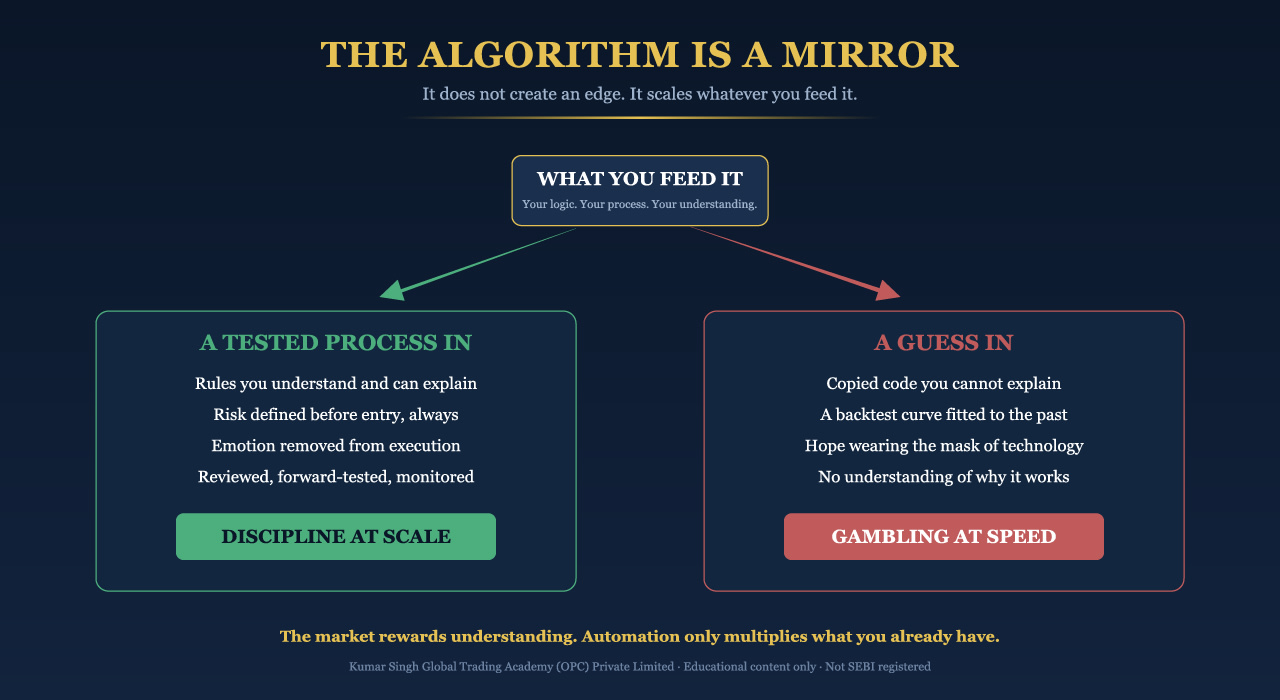
This is the first truth most traders skip: an algorithm is not a strategy. It is a delivery mechanism for a strategy. If the strategy inside it is empty, the algorithm delivers emptiness at high speed.
I will not pretend automation has no value. It solves three real problems that destroy manual traders every single day.
Most traders do not lose because their analysis is wrong. They lose in the gap between analysis and action. Hesitation on the entry. Panic on the exit. Doubling down after a loss. A machine feels none of this. If your rules are sound, automation protects the rules from you.
A written trading plan is a suggestion. Code is a commitment. The algorithm will not skip the stop because it has a feeling. It will not oversize because yesterday went well. For a trader who already has a process, this is the closest thing to forced discipline that exists.
Monitoring multiple instruments, reacting within milliseconds, logging every trade without bias. These are machine tasks. Using a machine for machine tasks is simply good engineering.
Now the part algo sellers will not enjoy.
Automation does not create an edge. It only scales one. And here is the brutal arithmetic: most retail traders do not have an edge to scale. They have a guess. When you automate a guess, you have not upgraded to professional trading. You have upgraded to faster gambling. More trades per day. Same coin flip underneath.
A trader spinning a roulette wheel once an hour and a trader running an unexamined bot firing fifty trades a day are doing the same activity. One of them just has better branding.
You cannot explain, in plain language, why the strategy should work in live markets.
You bought or copied the code and have never read its logic line by line.
Your confidence comes entirely from a back test chart, not from understanding market behavior.
You do not know under what conditions the strategy is supposed to fail.
You would not take these trades manually if you had to click the button yourself.
If three or more of these describe you, the machine is not trading. You are gambling through a machine.
Every sold algorithm arrives with a beautiful curve. Up and to the right. Smooth. Historical.
Here is what that curve usually hides. When you tune a strategy against past data long enough, it stops describing the market and starts describing the dataset. This is curve fitting. The strategy has memorized history, not understood structure. Live markets then hand it a future it has never memorized, and the beautiful curve meets reality.
A back-test is a filter, not a proof. It can tell you an idea is bad. It can never tell you an idea is good. Only forward testing, live observation, and a logic you actually understand can build that case. Anyone presenting a back test as a guarantee is selling you the past, priced as the future.
This section is for the sellers too. If you sell automation honestly, none of this should offend you.
Performance shown is historical and specific to conditions that no longer exist.
A strategy sold to thousands of buyers dilutes itself. Edges are finite. Crowded logic decays.
No seller can know your capital, your risk tolerance, or your ability to survive a drawdown. A tool sold without that context is a liability transferred, not a service rendered.
If the strategy truly printed money reliably, the rational business model is running it quietly, not retailing it with a landing page and a countdown timer.
None of this makes every algo seller dishonest. Some sell genuine tools to educated users. But the burden of understanding never transfers with the purchase. It stays with the trader. Always.
Here is the sequence that separates a trader from a hopeful gambler.
First, learn to read the market manually. Structure. Volume. Where participation concentrates and where it disappears. Understand why price moves, not just that it moved. This takes time and there is no shortcut through it, automated or otherwise.
Second, define a process. Written rules. Defined risk before entry. Known conditions for standing aside.
Third, and only third, consider automating that process. At this stage the algorithm becomes what it was always meant to be: a discipline machine wrapped around an understanding you already own.
Reverse this sequence and the technology cannot save you. Run it in order and the technology genuinely serves you. The market rewards understanding. Automation only multiplies whatever understanding, or lack of it, you bring to it.
Can I explain this strategy to another trader without using the word 'back test'?
Do I know the exact market conditions where this logic should stop working?
Have I traded this logic manually long enough to trust its behavior?
Is my risk per trade defined in the code, before entry, every time?
If this system drew down for three months, would I know whether it is broken or breathing?
A trader who can answer all five is ready to think about automation. A trader who cannot answer any of them is holding a lottery ticket that executes itself.
So, is algo trading helping traders or is it gambling? Wrong question. The right question is quieter and more personal: what am I about to automate?
Automate a tested process, and you get discipline at scale. Automate a guess, and you get gambling at speed. The algorithm is a mirror. It has always been a mirror. Look into it honestly before you switch it on.
This article is published for educational and informational purposes only. It does not constitute investment advice, trading advice, a recommendation, or a solicitation to buy or sell any financial instrument. Trading in financial markets involves risk. Readers are solely responsible for their own decisions and are encouraged to consult a qualified, registered financial adviser before acting on any information. Kumar Singh Global Trading Academy (OPC) Private Limited is not registered with SEBI or any financial regulatory authority worldwide. No content published by the academy should be interpreted as a price target, directional call, or assurance of outcome.
Not inherently. Algo trading becomes gambling when the automated logic has no understood edge behind it. The same strategy can be a disciplined process for one trader and a coin flip for another, depending entirely on whether the person understands why the logic exists.