We Teach Trading — Zero Tips, Zero Advice, Zero Recommendations. Not registered with SEBI or any financial regulator worldwide.
We Teach Trading — Zero Tips, Zero Advice, Zero Recommendations. Not registered with SEBI or any financial regulator worldwide.
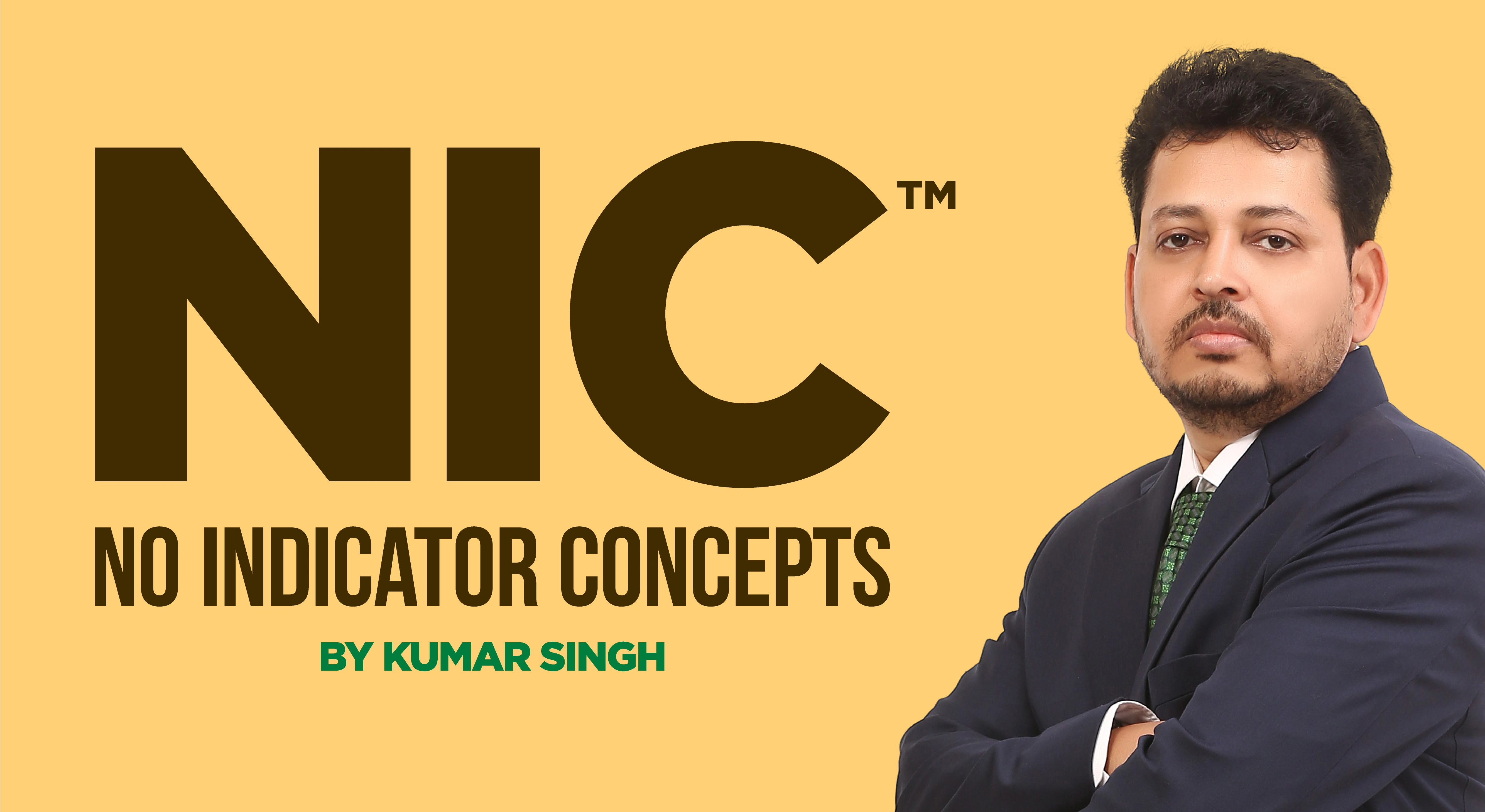
Read market structure, order flow, and volume footprint the way institutions actually trade. Live mentorship by Kumar Singh, taught across Indian and global markets through a structured curriculum.
NIC stands for No Indicator Concepts. It is a complete methodology for reading financial markets without using any technical indicators. No RSI. No MACD. No moving averages. No Bollinger Bands. No Stochastic. No Supertrend. Nothing on the chart except price, volume, and structure.
NIC was developed by Kumar Singh, founder of Kumar Singh Global Trading Academy. The methodology grew out of one stubborn observation made over years of live trading. Indicators are derivatives of price. They tell you what already happened. The market tells you what is happening right now. So why read the shadow when the object is right in front of you.
That question became NIC.
The methodology teaches traders to read three things directly off the chart. Structure. Order flow. Volume. These three forces drive every move in every liquid market on earth. Indicators repackage these forces into mathematical formulas that always arrive late. NIC removes the repackaging and teaches you to read the forces themselves.
Is NIC a real trading method. Yes. It is taught live to students through Kumar Singh Global Trading Academy. It has a defined curriculum, defined frameworks, and defined application across markets. Nine proprietary concepts form the core teaching architecture: Mother Candle Logic, Engulf Cycle, Volume Candle, Ascending and Descending Market Structure, Institutional Order Flow and Volume Footprint 1-2-3 Formula, Parallel Channel Structural Forecasting, Periodic Volume Profile Research, Institutional FVG Framework, and L1-L3 Candle Body and Wick Psychology.
NIC is not a signal service. Not a trading bot. Not an indicator with a clever name. It is a structural way of reading markets. A skill, taught in cohorts and one-on-one sessions, live.
Most traders who eventually find NIC arrive after they have tried everything else. Five indicators. Ten indicators. Fifteen indicators stacked on the same chart. The signals contradict. The system whipsaws. The losses pile up. Sound familiar?
There is a structural reason this happens. It is not because you picked the wrong indicators. It is because indicators have three problems built into how they work.
First, indicators lag. Every indicator is calculated from price data that has already printed. By the time RSI tells you the market is overbought, the move has already happened. By the time MACD crosses, the institutions that moved the price are already exiting their positions. You are reading yesterday's news and trying to trade tomorrow with it.
Second, indicators repaint. Many of the most popular indicators redraw themselves after the fact. The signal you saw on the live chart at 9:30 looks completely different on the same chart at 3:30. The backtest that looked beautiful was using the repainted version. The forward test loses money because you cannot actually trade what only exists in hindsight.
Third, indicators mask what is actually happening. Price moves because money moves. Institutional orders, real volume, real structural pressure. Indicators compress this information into a single line on a sub-chart. You stare at the line. You miss the market.
NIC removes all three problems by removing the indicators. You read the market directly. The price chart, the volume, the order flow. Nothing in between you and what is actually happening.
NIC works because it teaches you to read what indicators are derived from in the first place. The methodology is built on four pillars. Each pillar contains specific frameworks. Each framework has a defined application. Students learn the frameworks in sequence and progress to combining them into complete reads of any market.
This is the foundation. Markets do not move randomly. They move in structures. Mother Candle Logic teaches students to identify the candles that contain the next move before the move happens. Volume Candle reading reveals which candles carry institutional commitment and which are noise. Engulf Cycle frameworks track how markets transition between accumulation, expansion, and distribution. Ascending and Descending Market Structure provides the directional bias that anchors every other read.
This is how NIC handles market structure without indicators. Pure observation of how price builds and breaks structure on the chart in front of you.
Indicators try to infer order flow indirectly. NIC reads it directly. The Institutional Order Flow and Volume Footprint 1-2-3 Formula gives students a defined sequence for identifying where institutional orders are entering and exiting. The Institutional FVG Framework teaches students to read Fair Value Gaps as structural evidence of imbalance, not just as a chart pattern. Parallel Channel Structural Forecasting provides geometric context for where order flow is most likely to react.
This is how NIC reads institutional order flow without any indicator. The footprint of the institutions is already on the chart. NIC teaches you to see it.
Volume is the language of conviction. NIC uses Volume Profile to understand where price has been accepted and where it has been rejected. Periodic Volume Profile Research, a Kumar Singh proprietary framework, extends standard volume profile concepts into time-segmented readings that reveal session-by-session institutional behavior. Volume Footprint reading teaches students to interpret the bid-ask delta within each candle, which is where institutional activity becomes most visible.
This is how to read volume footprint in NIC. Not as a fancy chart overlay. As a language of real money moving real markets.
Every candle tells a story. The L1-L3 Candle Body and Wick Psychology framework decodes that story. The body shows where commitment landed. The wick shows where commitment was tested. The relationship between bodies and wicks across consecutive candles reveals the psychology of every participant in that timeframe.
These four pillars combine. Students learn each pillar individually and then study how they overlap. The overlap is where high-confluence reads happen. The methodology is taught systematically across the program ladder, starting with foundational concepts in NIC Fundamentals and scaling into the full architecture across the twenty modules of NIC Pro.
NIC is instrument-agnostic by design. The methodology reads three forces, structure, order flow, and volume, that exist in every liquid market on earth. Students apply the exact same frameworks on a five minute Bank Nifty futures chart, a daily S&P 500 chart, and a Bitcoin chart. The chart changes. The reading method does not.
This is one of the most common questions traders ask when they first encounter NIC. Does this work for my market. The answer is structural. If your market has price action, volume, and enough liquidity to produce real institutional participation, NIC applies.
Students apply NIC frameworks across the full range of Indian instruments. NIFTY 50 index and NIFTY futures. Bank Nifty index and futures. Sensex. Fin Nifty. Midcap Nifty. Individual NSE and BSE listed stocks. The methodology adapts cleanly across intraday, swing, and positional timeframes. Volume Footprint reading on Indian futures contracts reveals institutional positioning that indicator-based approaches miss entirely.
The same frameworks apply on US index instruments. S&P 500 and ES futures. Nasdaq 100 and NQ futures. Dow Jones futures. Students who study global indices alongside Indian markets often find that NIC reads the same structural language regardless of which exchange the chart sits on. Mother Candle Logic on Bank Nifty looks structurally identical to Mother Candle Logic on the S&P 500. Because markets are markets.
Crude oil, natural gas, gold, and silver all carry the structural patterns NIC reads. Gold is one of the markets where students find the methodology particularly clean to study, because the institutional flow on XAUUSD is large enough to print clear footprints. Energy markets like crude and natural gas produce strong Volume Profile reads because session-by-session volume distribution is so distinct.
Major currency pairs and cross pairs are accessible to NIC frameworks wherever genuine institutional flow is present. The methodology teaches students to read where banks and funds are positioning, which is the actual driver of forex movement underneath the surface of any indicator-based signal.
Wherever sufficient liquidity exists, NIC applies. Students study order flow and Volume Footprint readings on Bitcoin and Ethereum, the two cryptocurrencies with deep enough institutional participation to produce reliable structural reads. NIC frameworks make no distinction between asset classes. The structural concepts apply identically because price action is price action regardless of the underlying asset.
NIC reads the underlying market. Once a student can read the underlying, the application extends naturally into futures trading and options trading. Options Greeks add a derivative reading layer that NIC Pro covers in the closing modules of the curriculum, teaching students to overlay institutional positioning evidence onto options chains for higher confluence reads.
What unifies all of this is the constancy of the method. Students who learn NIC do not have to learn a new system every time they switch markets. The chart changes. The instrument changes. The reading stays the same. Students working across multiple instruments often choose the twenty module NIC Pro program for the complete methodological architecture, with one-on-one mentorship available for those who want personalized progression across their specific market focus.
Most traders who reach NIC have already tried other methodologies. SMC. ICT. Wyckoff. Supply and demand. Pure price action. The question they bring is fair. How is NIC structurally different.
SMC focuses primarily on identifying where smart money has entered and exited based on liquidity sweeps, order blocks, and structural breaks. It is a strong methodology and has helped many traders move past indicators. NIC extends the SMC layer with explicit Volume Footprint reading, Periodic Volume Profile Research, and Institutional Order Flow 1-2-3 Formula frameworks. Where SMC stops at structural identification, NIC adds the volume-level evidence of institutional commitment. The two approaches share roots in reading institutional behavior. NIC adds more layers of structural confluence.
Which is better, NIC or SMC. There is no universal answer. Traders who want pure structural identification often find SMC sufficient. Traders who want structure plus volume plus order flow integrated into a single methodology tend to prefer NIC.
ICT introduced many traders to concepts like Fair Value Gaps, liquidity zones, and order blocks. The ICT framework is rich and influential. NIC's Institutional FVG Framework is a more codified application of FVG reading specifically, with defined entry context, structural anchor requirements, and confluence with Volume Footprint evidence. The difference between NIC and ICT comes down to teaching architecture. ICT covers a vast range of concepts. NIC focuses on a defined methodology with a fixed twenty module curriculum and proprietary frameworks that integrate structure, order flow, and volume footprint.
This is the largest contrast. Indicator trading uses mathematical derivatives of price as the primary read. NIC uses price, volume, and order flow directly. Traditional technical analysis combines indicators with chart patterns and oscillators. NIC removes the indicators entirely and teaches the underlying forces those indicators were trying to approximate.
NIC shares the philosophical foundation of these approaches. All of them reject indicator dependency. The difference is depth of structural framework. NIC's nine proprietary concepts provide a defined teaching architecture, defined application sequence, and codified frameworks that students learn module by module rather than picking up piecemeal from scattered sources.
For traders who want a side-by-side breakdown, the dedicated comparison pages cover the full NIC vs SMC and NIC vs ICT distinctions in detail.
NIC is not for everyone. The methodology requires discipline, time, and a willingness to study markets seriously rather than chase signals. Students who succeed in the program typically fall into three groups.
Traders who need to understand why every move happens. They are not satisfied with rules they cannot reason about. They want to read markets the way a forensic investigator reads a scene. NIC gives them the framework to dissect every structural event, every volume signature, every order flow shift.
Traders who treat trading as a serious professional skill. They have run businesses, managed risk in other domains, and understand that real expertise is built over years not weekends. They are looking for a complete methodology, not a shortcut.
Traders who want a complete framework rather than piecemeal techniques collected from a hundred YouTube videos. They value internal consistency in a methodology. They want the modules to connect, the concepts to compound, and the teaching to scale from foundation to advanced application in a coherent sequence.
Serious traders building this as a long-term skill choose NIC Pro 1:1 for the personalized progression structure. Group cohorts are available through NIC Pro Group for those who prefer a shared learning environment.
NIC No Indicator Concepts is an educational methodology taught by Kumar Singh Global Trading Academy (OPC) Private Limited (CIN U85490BR2026OPC081312). All content on this page is for educational purposes only. Nothing on this page is investment advice, financial advice, a recommendation to buy or sell any security, or a guarantee of any financial outcome.
Trading in financial markets involves substantial risk of loss. Past performance is not indicative of future results. No methodology, including NIC, can eliminate the risks inherent in trading. Each individual student is responsible for their own decisions, risk management, and outcomes.
Kumar Singh Global Trading Academy is not registered as an investment advisor with SEBI or any other financial regulator. The Academy provides education and skill development only. Students seeking investment advice should consult a SEBI-registered investment advisor in India or the equivalent regulated professional in their jurisdiction.
This page is intended for adult readers who are studying trading as a skill. It is not intended for jurisdictions where such educational content is restricted.
NIC is a methodology taught live by Kumar Singh Global Trading Academy. The full registered entity is Kumar Singh Global Trading Academy (OPC) Private Limited, CIN U85490BR2026OPC081312, operating in alignment with SEBI guidelines and global regulatory standards. It is a defined educational program with a published curriculum, not a signal service and not a financial advisory.