We Teach Trading — Zero Tips, Zero Advice, Zero Recommendations. Not registered with SEBI or any financial regulator worldwide.
We Teach Trading — Zero Tips, Zero Advice, Zero Recommendations. Not registered with SEBI or any financial regulator worldwide.
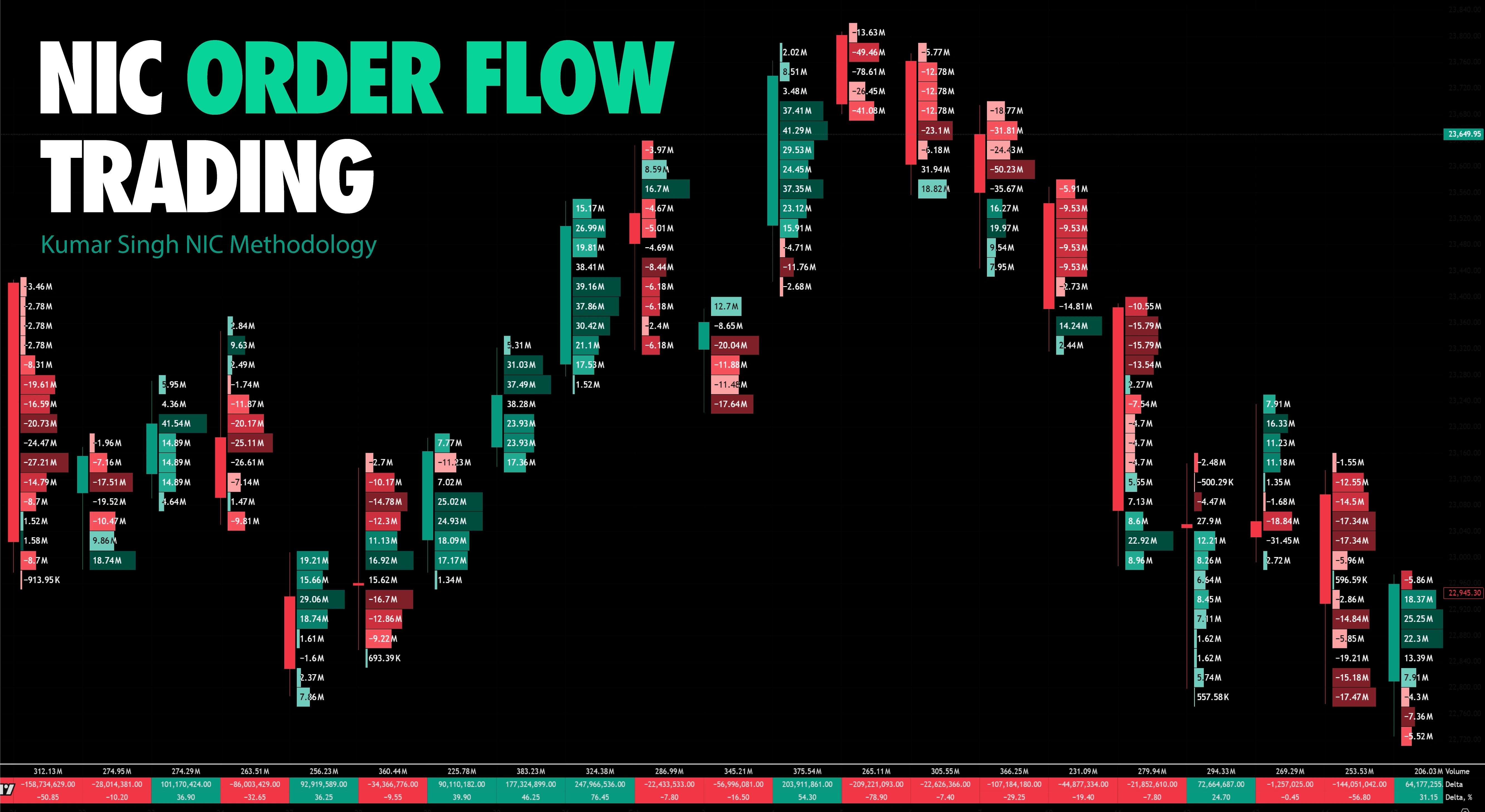
Most traders read the chart. A small percentage read the order book behind it. That difference is order flow trading. The complete practitioner's guide to how it works, the software and data behind it, and the structured path to learning it.
Order flow trading is the practice of reading actual buy and sell activity at each price level, rather than reading lagging calculations derived from past price.
Where indicator-based methods look at moving averages, RSI, MACD, or other historical formulas, order flow looks at the raw data underneath the chart. How much volume transacted at the bid versus the ask. Where large orders are stacking. Where institutional players are absorbing supply. Where retail is getting trapped.
It is the closest a retail or independent trader gets to reading what the participants behind the price action are actually doing.
Order flow has four core data layers.
Bid and Ask Volume. Every traded contract or share happened on either the bid (a seller hit a buy order) or the ask (a buyer lifted a sell offer). Tracking this in real time shows directional pressure.
Delta. The net difference between buying and selling volume at each price. Positive delta means aggressive buyers. Negative delta means aggressive sellers. Sustained delta divergence is often the first sign of an institutional reversal zone.
Volume Profile. A histogram showing how much volume was transacted at each price level over a session. The level with the highest volume becomes the Point of Control (POC), a key institutional reference.
Footprint Charts. A candle-based visualization where each candle shows the internal bid-ask volume breakdown. This is where the actual order flow becomes structurally readable.
Together, these four layers give a trader a complete picture of who is in control at any price. Not a lagging signal from a historical calculation.
The honest answer: outcomes in any trading approach are a function of the trader's skill, discipline, and risk management. Not the method itself.
What order flow offers structurally is a more accurate reading of market activity than indicator-based methods. It aligns the trader with the same data institutional participants are reading. Whether that alignment translates into financial outcomes depends entirely on:
How rigorously the framework is applied
How disciplined risk management is
How well psychological pressure is controlled
How consistently trades are journaled and refined
Order flow is a skill-based reading discipline. Like any skill, the outcome depends on the practitioner.
For analytical traders who want to understand cause-and-effect in markets, yes. Order flow is one of the most structurally sound approaches available. It shifts the trader from reacting to the chart to reading the market underneath the chart.
It is not for everyone.
It requires more screen time to learn properly.
It needs proper data and software, not free indicators.
It rewards patience and disqualifies impulse trading.
For traders who prefer push-button signals, order flow will feel slow. For traders who want to understand markets at a structural level, it is the deepest approach available.
Yes. Institutional desks, prop trading firms, market makers, and serious independent traders all rely on order flow in some form.
The reason is straightforward. Institutions are the entities placing the large orders that move price. They are not waiting for a moving average crossover. They are reading the order book, positioning around liquidity zones, and executing in size. Order flow is the language they use to operate.
Order flow has a steeper learning curve than indicator-based trading. There is no shortcut. The structured path looks like this.
Stage 1. Foundation in price action. Before reading order flow, you need to read clean price structure. Candle anatomy. Body and wick psychology. Market structure. Support and resistance as structural zones, not lines.
Stage 2. Volume reading. Volume profile. Point of Control. Value area. Periodic volume profile.
Stage 3. Delta and footprint. Bid-ask analysis. Delta divergences. Footprint imbalances. Cluster reading.
Stage 4. Institutional context. Fair value gaps. Liquidity pools. Institutional reference levels. CVD. VWAP as a contextual tool.
Stage 5. Application and discipline. Setup classification. Risk management. Journaling. The psychological discipline to sit out non-setup days.
Self-learning is possible but slow. Structured mentorship compresses the timeline significantly.
Kumar Singh Global Trading Academy teaches this exact path through the NIC Pro Mentorship (Institutional Order Flow and Volume Footprint) for serious practitioners, and NIC Fundamentals for traders starting from zero.
Retail traders who learn to read order flow are essentially learning to read the same data the institutions are watching. Just from the outside.
The most widely used order flow platforms among serious traders globally.
Platform | Strength | Suited for |
|---|---|---|
Sierra Chart | Deep footprint and DOM tools, professional grade | Futures traders |
Bookmap | Heatmap-based order book visualization | Visualizing live liquidity |
NinjaTrader | Integrated footprint, large ecosystem | US futures, ES, NQ |
ATAS | Footprint, cluster analysis, deep customization | Order flow specialists |
MotiveWave | Advanced footprint and volume tools | Multi-asset analysts |
TradingView | Volume profile and footprint via paid tier | Indian equity, global cross-asset |
Quantower | Modern interface, full order flow suite | Multi-market traders |
There is no single best platform. The right choice depends on:
The market traded (Indian equity, US futures, forex, crypto)
The data feed available
The trader's budget
The existing workflow
TradingView offers basic order flow functionality through its volume profile and footprint chart features, available on its higher-tier paid plans (Premium and above).
What TradingView does well.
Clean volume profile (visible range, fixed range, session)
Basic footprint chart with bid-ask delta
Strong for structural mapping, support and resistance zones, value area reading
What TradingView does not do as deeply as dedicated order flow software.
Live DOM with order book heatmap
Cluster-level footprint analysis
Advanced delta divergence detection
Tick-by-tick order flow replay
For most Indian and global retail traders starting out, TradingView is sufficient to build structural order flow reading skills before moving to dedicated platforms.
Order flow analysis is only as good as the data feeding it. The main sources.
For Indian markets. NSE and BSE feeds through brokers like Dhan, Zerodha (via Kite), Upstox, Fyers, Angel One, and ICICI Direct. Most provide volume and basic profile data. For tick-level data, GlobalDataFeeds and TrueData are the standard.
For US futures. CME data through Sierra Chart, NinjaTrader, or Rithmic feeds.
For global cross-asset. Polygon.io, Databento, and exchange-direct feeds.
Free data is almost always insufficient for serious order flow analysis. Real-time tick data is the minimum requirement.
A clarification first. Order flow tools on TradingView are not "indicators" in the traditional lagging sense. They are visualization layers over actual transaction data.
The most widely used order flow visualization tools on TradingView.
Periodic Volume Profile — built into TradingView Premium
Volume Profile Fixed Range — for specific session analysis
Session Volume Profile — daily session reading
CVD (Cumulative Volume Delta) — net buying versus selling over time
VWAP and Anchored VWAP — institutional reference level
Footprint Charts — bid-ask volume breakdown per candle (paid tier)
Treating these as indicators leads to indicator-style trading. Looking for signals. The correct approach is to use them as structural data layers, reading what the market is actually doing at each price.
A direct point on this. Most free PDFs and free courses available online for order flow trading are either outdated, oversimplified, or written by people who do not actually trade order flow.
Real order flow education has four characteristics.
Built on actual market data, not theoretical examples
Includes a structural framework, not just definitions
Teaches risk management and psychology alongside the technical reading
Comes from someone with verifiable trading and teaching experience
Kumar Singh Global Trading Academy offers structured NIC Fundamentals and NIC Pro programs covering the complete order flow and volume footprint methodology. Free YouTube content is available at @KumarSingh on YouTube for traders who want to assess the methodology before committing to structured mentorship.
A weekly free Google Meet session runs every Sunday at 9 PM IST for serious traders to engage directly with Kumar Singh.
This statistic is widely cited, including in studies by SEBI and global regulators. The structural reasons most option traders struggle.
No structural reading of the underlying. Option traders often look at the option chain in isolation, without reading the underlying's structure and order flow.
Outcome-chasing trades. Buying options based on tips, news, or sentiment. Not structure.
Poor risk management. Position sizing too aggressive relative to capital.
Greeks misunderstood. Delta, IV, PCR, and theta decay treated as abstract numbers rather than practical tools.
No defined edge. Trading without a setup framework.
Option trading without an underlying order flow reading is essentially guessing. With order flow underneath, option execution becomes a precision tool. The underlying tells you when the structure is aligned for the trade.
The 3-5-7 rule is a risk management heuristic used by some retail traders.
3% maximum risk per individual trade
5% maximum risk across all open positions at any time
7% maximum total drawdown threshold before stopping and reassessing
It is a guideline, not a system. The actual percentages depend on account size, market volatility, and overall risk tolerance. Some practitioners use stricter variants (1-2-5 or 0.5-2-4). The principle matters more than the exact numbers.
Define risk before entry. Cap total exposure. Stop trading when drawdown crosses a threshold.
Risk rules without a structural setup framework do not produce results. Both are needed.
The NIC method (No Indicator Concepts) is built entirely around institutional order flow and volume footprint reading. The methodology covers.
20 modules across 5 phases
Live mentorship with Kumar Singh
Same complete curriculum in both 1-on-1 and Group formats
Foundation through advanced application
Risk management and psychology integrated throughout
Programs available.
Program | Format | Suited for |
|---|---|---|
Individual, 20 modules | Traders wanting personalized depth | |
Small cohort, 20 modules | Same depth, cohort format | |
Group cohort, 6 modules | Entry point, no-indicator foundation |
Free content available on @KumarSingh on YouTube and through the weekly Sunday Google Meet session.
Treating footprint as a signal generator instead of a reading lens.
Skipping the structural foundation and jumping straight to delta.
Trading every imbalance without setup classification.
Ignoring risk management because the entry "looked perfect."
Overusing alerts and reducing screen time.
The traders who build durable skill with order flow are the ones who treat it as a reading discipline. Not a signal system.
Order flow trading is the most structurally sound approach available to serious traders. It aligns the trader with the actual mechanics of how institutions move markets. The learning curve is real. The discipline required is substantial. The reward is a complete framework for reading markets, not chasing signals.
For traders ready to learn it properly, structured mentorship compresses the timeline significantly.
The market has a language. Learn to read it.
Kumar Ravishanker Singh — professionally known as Kumar Singh — is an independent trader, mentor, and the founder of Kumar Singh Global Trading Academy (OPC) Private Limited (KSGTA). He runs the Trade Ed podcast, the @KumarSingh YouTube channel, and the NIC mentorship programs serving traders across India and globally.
Kumar Ravishanker Singh — professionally known as Kumar Singh — and Kumar Singh Global Trading Academy (OPC) Private Limited (KSGTA) provide educational content only. Nothing in this article constitutes investment advice, financial advice, a recommendation to buy or sell any security, or a guarantee of any outcome. Trading and investing in financial markets involve substantial risk of loss. Past performance of any methodology, framework, or market does not indicate future results. Readers are responsible for their own decisions and should consult a SEBI-registered investment advisor before making any investment decision.
For analytical traders who want to understand cause-and-effect in markets, order flow is one of the most structurally sound approaches available. It shifts the trader from reacting to the chart to reading the market underneath the chart.