We Teach Trading — Zero Tips, Zero Advice, Zero Recommendations. Not registered with SEBI or any financial regulator worldwide.
We Teach Trading — Zero Tips, Zero Advice, Zero Recommendations. Not registered with SEBI or any financial regulator worldwide.
The complete, no-hype guide to forex and futures prop firm trading for Indian traders. Real payout data, RBI and FEMA position, income tax on payouts, the rules that break funded accounts, and what it actually takes to get paid. Written by a trader who has read markets since 1994.
Every week my phone fills up. WhatsApp messages, missed calls, DMs. Most of them start with mentorship and end with one question: "Sir, which prop firm should I join?"
Some want to get rich fast. Some want to recover losses they already took in options or crypto. Some honestly believe a $100,000 funded account is the start of a trading career.
I understand the pull. You pay a few thousand rupees, you get "access" to lakhs or crores of capital, and you keep 80% or 90% of the profit. It sounds like the shortcut every struggling trader has been praying for.
It is not a shortcut. For most people it is the most expensive way to find out they cannot trade yet.
This article is my answer to every one of those messages. I have kept it factual, point-wise and backed by published data. Read it fully before you pay any prop firm a single rupee.
Quick disclosure: I do not run a prop firm and I do not promote any prop firm. Nothing here is investment, legal or tax advice. It is education. Kumar Singh Global Trading Academy is not registered with SEBI or any financial regulatory authority worldwide.
Are prop firms legal in India? No Indian law specifically legalises or bans retail prop firm challenges. Offshore forex prop firms sit in a grey zone under FEMA, and the RBI has already put two prop firms, FundedNext and Smart Prop Trader, on its Alert List of unauthorised forex platforms. "Not banned by name" is not the same as "legal and protected".
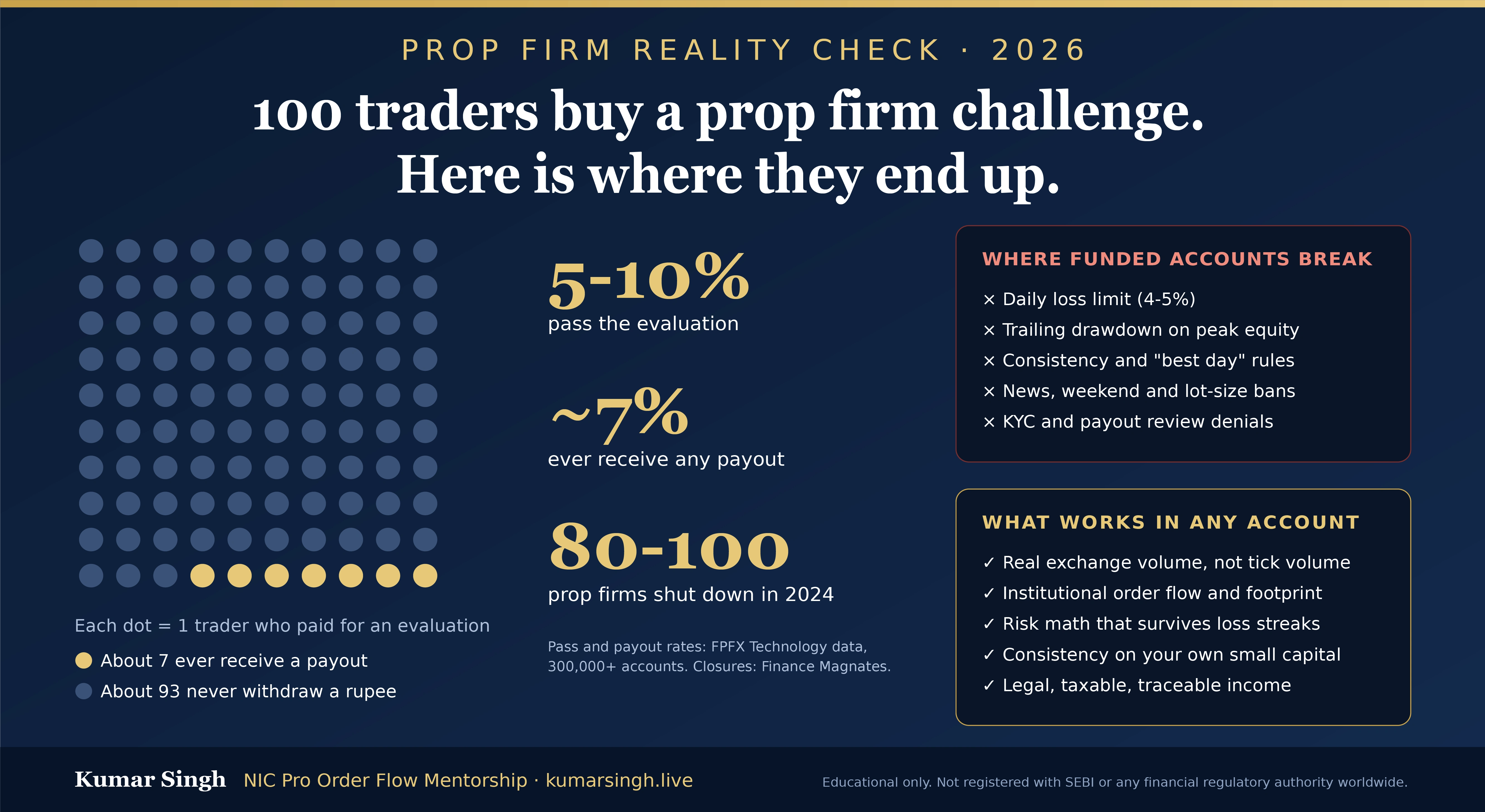
Do prop firms really pay? Some do. Industry data from FPFX Technology covering 300,000+ accounts shows only about 7% of traders who buy a challenge ever receive a payout, and roughly 5% to 10% pass the evaluation.
Is a prop firm payout taxable in India? Yes. For a resident Indian it is taxable income, most defensibly business income taxed at your slab rate. Taking it in crypto adds a second tax layer.
Can prop firm trading bring an income tax notice? Yes, if foreign credits or crypto flows hit your accounts and you do not declare them.
Should a beginner join a prop firm? No. If you cannot stay consistent with ₹50,000 of your own money, a $100,000 simulated account will not change your result. It only changes the size of the fee you lose.
What actually works? Real trading skill. Reading real volume, institutional order flow, disciplined risk, and consistency on small capital first.
"Prop" is short for proprietary. A proprietary trading firm trades its own money for its own profit. That is the original meaning, and it is very different from what you see in Instagram ads.
Today the word covers two completely different businesses:
Feature | Real Proprietary Trading Firm | Retail "Prop Firm" (Challenge Model) |
Who pays whom | The firm pays you a salary or stipend plus incentive | You pay the firm a challenge fee |
How you get in | Interviews, tests, often a finance or maths background | Buy a challenge online in two minutes |
Capital | Real firm capital in live markets | Mostly simulated (demo) capital |
Regulation | Usually a registered broker, trading member or regulated entity | Usually unregulated, sells an "evaluation service" |
Main revenue | Trading profits | Challenge fees, resets and add-ons |
Examples of the model | Market makers, HFT firms, bank-era prop desks, broker prop desks | Online forex, futures and crypto challenge firms |
When a trader in India says "prop firm", 99% of the time he means the second type. That is the type this article is about.
Here is the standard structure. Names change from firm to firm. The mechanics do not.
You buy a challenge. A fee between roughly $50 and $1,000+ depending on account size ($5,000 to $200,000 is common).
Phase 1 (evaluation). Hit a profit target, usually 8% to 10%, without breaching a daily loss limit (often 4% to 5%) or a maximum drawdown (often 8% to 10%). Many firms also demand a minimum number of trading days.
Phase 2 (verification). A second, smaller target, usually around 5%, under the same loss rules.
"Funded" account. You now trade what the firm calls a funded account. In most retail models this is still a simulated account. Your trades may or may not be copied to a live market. Your profit split is paid out of the firm's money, not out of a real market fill in your name.
Payout request. After a waiting period (often 14 to 30 days, some firms offer faster cycles), you request a payout. The firm reviews your trades before approving it.
Scaling. If you keep hitting targets, some firms raise the account size.
Variations you will see advertised
One-step challenge: one phase, but tighter drawdown or higher fee.
Instant funding: no evaluation, but a higher price, tighter drawdown and lower profit split. You are paying more for the same odds.
Pay after you pass / pay later: a smaller entry fee now, a bigger fee after you pass. The firm still collects from the majority who fail.
Free trial account: a demo to get you comfortable with their platform. No firm gives a funded account for free.
Resets and refunds: reset a failed challenge at a discount. The fee refund is usually paid only with your first payout, which most traders never reach.
This is the most important section in the whole article. Once you understand this, you understand everything.
A retail prop firm is mainly a fee business, not a trading business.
Challenge fees are the core revenue. They are collected upfront from every trader, including the 90%+ who fail.
Resets, retries and add-ons (extra days, higher split, "payout boost") add more revenue from the same failing traders.
Simulated accounts mean the firm usually carries no market risk on your trades. When you lose, nothing leaves the firm. When you win, the firm pays you from the fee pool.
Some firms copy consistent winners to live markets and trade their signals. That is the only part that resembles real prop trading.
An illustrative example (hypothetical numbers)
A firm sells 10,000 challenges at $300 each. Revenue: $3,000,000.
Around 7% of buyers ever get paid. That is 700 traders.
Suppose each of them receives $1,500 in total payouts. Cost: $1,050,000.
The firm keeps about $1.95 million before salaries, marketing and technology.
The firm does not need you to lose. It needs most traders to fail and a few to win publicly. The winners become the marketing.
The uncomfortable truth: a model built on fees stays healthy only while new traders keep buying. When sign-ups slow and payout requests rise together, weak firms either tighten rules, delay payouts, or disappear. That is exactly what happened in 2024.
Traders search "prop firm payout", "prop firm payout tracker", "prop firm payout leaderboard" and "prop firm payout certificate" every day. Here is what the published numbers say.
About 7% of all traders who buy a challenge ever receive a payout. This comes from FPFX Technology data covering more than 300,000 accounts across multiple firms, and it is the most cited figure in the industry.
Only 5% to 10% pass the evaluation, most commonly on the first attempt.
Even after being funded, many never get paid. Topstep's own disclosure for 2025 showed that 33.3% of individual participants who reached its Funded Level received a payout. Two out of three funded traders there got nothing that year.
Most payouts are small. Payout tracking sites report that most verified payouts fall between $200 and $2,000. These are monthly withdrawals, not life-changing windfalls.
Payout certificates are marketing. They prove one person got paid once. They say nothing about your odds.
Payout leaderboards show the top of the pyramid. You never see the thousands of failed accounts under them.
Payout trackers and analytics (for example the payout tracker on Prop Firm Match) are useful, because they track payouts that actually happened. But they track payouts, not denials. Always read them next to the firm's rules and complaint history.
Trustpilot reviews can be gamed in both directions. Ignore the five-star flood. Read the one-star and two-star reviews and look for patterns: "payout denied", "account breached for gambling behavior", "KYC rejected after passing". A pattern is more reliable than a rating.
This is where most traders lose. Not in the market. In the rulebook. Read each rule carefully, because each one is a trap for a specific kind of trader.
Usually 4% to 5% of the starting balance or of the day's opening equity.
Some firms count floating (unrealized) loss. You can breach the account while a trade is still open and would have recovered.
One bad news candle, one gap, one slippage fill, and the account is gone.
Static drawdown: your floor stays fixed. A $100,000 account with 10% max drawdown can never go below $90,000.
Trailing drawdown: your floor moves up as your account makes new highs. It never moves down.
Trailing drawdown example (common in futures prop firms): $50,000 account, $2,000 trailing drawdown. Your floor starts at $48,000. Intraday, an open trade takes your equity to $51,500, so the floor moves up to $49,500. The trade reverses and you close at $50,200. You are $200 in profit, but you now have only $700 of room left. Many traders get breached while being in profit overall.
Common form: no single day can be more than 30% to 50% of your total profit.
Hit one big day and you must keep trading, and taking more risk, to "dilute" it before you can withdraw.
Some firms apply this rule at payout review, after you thought you were done.
Minimum days force you to trade when there is no setup.
Time limits (where they still exist) push traders to overtrade near the deadline.
Many firms ban trading around high-impact news or holding positions over the weekend.
Breaking these rules, even by accident, can void profits.
Maximum lot size, maximum risk per trade, bans on "all-in" behavior.
Vague clauses like "trading not consistent with real market behavior" give the firm wide discretion at payout time.
Copy trading across firms, hedging across accounts, tick scalping, latency arbitrage, news straddles, some EAs and bots.
A strategy that passed the challenge can be declared "prohibited" at payout review.
Several firms have restrictions on certain countries, VPN use, shared devices or IP addresses.
KYC is often checked only when you request your first payout. Indian traders have reported rejections at exactly that stage.
On a simulated account, spreads, commissions and slippage are whatever the firm's system applies.
You cannot independently verify fills the way you can with an exchange contract note.
Prop firm drawdown rules turn normal statistics into account killers. This is pure probability, no opinion.
Take a trader with a 45% win rate (normal for a 1:2 risk-reward approach) taking 100 trades. I ran the simulation:
Losing streak within 100 trades | Probability it happens at least once |
5 losses in a row | About 92% |
8 losses in a row | About 31% |
10 losses in a row | About 10% |
Now look at what that streak does to a 10% maximum drawdown:
Risk per trade | Consecutive losses to breach 10% drawdown | Losses to breach a 5% daily limit |
2% | 5 | 3 |
1% | 10 | 5 |
0.5% | 20 | 10 |
A trader risking 2% per trade will almost certainly see a 5-trade losing streak. That streak alone ends the account. This is why "prop firm pass strategies" that push 2% to 3% risk are a lottery ticket dressed up as a method.
People search "why prop firms are closing" and "are prop firms reliable". The last three years answer both.
June 2023: the US CFTC added True Forex Funds to its RED List, the first prop firm specifically named there. The firm closed in 2024 with traders reporting unpaid balances.
August 2023: the CFTC charged My Forex Funds with fraud, alleging over $300 million in fees from more than 135,000 customers and alleging that traders were led to believe their accounts were live when they were simulated. Canada's Ontario Securities Commission also acted. Operations stopped and payouts froze.
2025 twist: a US federal court dismissed the CFTC case with prejudice and sanctioned the regulator for misconduct in how it ran the case. The firm won legally. But traders with pending payouts waited years. When a prop firm stops, your money stops with it, whoever is right in court.
February 2024: MetaQuotes, the company behind MetaTrader 4 and 5, abruptly cut platform access for a number of prop firms operating through grey-label arrangements. Firms without a backup platform or broker collapsed within weeks. The broker Eightcap also withdrew prop firm services.
2024 overall: Finance Magnates Intelligence estimated that 80 to 100 prop firms shut down in 2024 alone.
By March 2026: Finance Magnates reported that nearly one-third of the prop firms it tracked had disappeared or gone inactive in under two years.
Firms close for three reasons: platform or broker dependency, regulatory pressure, and a fee-funded model that cannot survive slower sign-ups. None of those is something you can control as a trader.
This is the most searched question from Indian traders: "is prop firm legal in India", "prop firm forex legal in India", "is prop firm trading legal in India". Here is the honest, structured answer.
Under the Foreign Exchange Management Act, 1999 (FEMA), a resident Indian can deal in foreign exchange only with authorized persons and only for permitted purposes.
Retail forex trading is permitted only on recognized Indian exchanges (NSE, BSE, MSE) or on RBI-authorized electronic trading platforms, in rupee pairs and a small set of permitted cross-currency pairs. The current framework is the RBI's Master Direction on Electronic Trading Platforms, 2025.
The Liberalized Remittance Scheme (LRS) does not permit remittances for margin or margin calls to overseas exchanges or counterparties.
The RBI has warned that residents dealing on unauthorized platforms are liable for penal action under FEMA.
The RBI Alert List: in October 2024 the RBI added FundedNext and Smart Prop Trader to its Alert List of entities not authorized to deal in forex or operate forex trading platforms. The list stood at 95 names after the November 2025 update and it includes several global brokers and the MetaTrader platforms themselves.
"Not on the list" does not mean approved. The RBI says clearly that the list is not exhaustive and absence from it should not be taken as authorization.
Prop firms argue that you only buy a "simulated evaluation service", so no forex transaction happens. That argument has never been tested by the RBI in a public ruling. When the product is leveraged forex CFD exposure with real money coming back to you, calling it a "service" does not settle the FEMA question.
The Alert List also names entities promoting unauthorized platforms, including through advertisements or by claiming to offer training or advisory services linked to them. Educators and influencers pushing affiliate links carry their own risk here.
Real proprietary desks exist in India. They are run by SEBI-registered brokers and trading members using their own capital, and they hire traders.
Online "funded trader" programs that let you trade simulated positions on live NSE or BSE prices are a different thing. In November 2024 SEBI issued an advisory against platforms offering virtual trading, paper trading or fantasy games based on real-time price data of listed companies. The advisory did not name prop firms, but the model sits uncomfortably close to it.
Be very careful with any "Indian prop desk" asking for a security deposit from you. Anything that settles profit and loss off-exchange starts looking like dabba trading, which is illegal.
Question | Honest answer |
Is there an Indian law naming prop firms? | No |
Has the RBI flagged any prop firm? | Yes, FundedNext and Smart Prop Trader (October 2024) |
Is an offshore forex prop firm authorized by RBI? | No. None is on the RBI authorized ETP list as far as published records show |
Is it a FEMA grey zone? | Yes, and forex is the riskiest category |
If the firm freezes your account, can SEBI or RBI help you? | No. Offshore evaluation firms sit outside Indian investor protection |
Is your payout taxable? | Yes, full |
"Legal" and "protected" are two different words. At best, an Indian trader using an offshore forex prop firm is in an unprotected grey zone. At worst, he is on the wrong side of FEMA.
Yes. And many traders find out the hard way.
A prop firm payout is income. It is not a gift, not a prize you can ignore, and not "foreign money that India cannot see".
The most defensible classification for a regular trader is income from business or profession, taxed at your normal slab rate. That usually means filing ITR-3, not ITR-4.
Because it is business income, genuine expenses such as challenge fees, data and platform subscriptions, internet and equipment may be deductible. Confirm with your CA.
If you trade from India, the income is generally treated as arising in India, even if the payer is abroad.
The new Income-tax Act, 2025 is in force from 1 April 2026 and many section numbers have changed. Old YouTube videos quoting section numbers may be outdated.
Bank payout: cleaner. You get an inward remittance with a proper purpose code and bank records. Keep your FIRC or bank advice.
Crypto payout (USDT to Trust Wallet or an exchange): you still owe income tax on the payout itself. Then, when you sell or transfer the crypto, India's Virtual Digital Asset regime applies: a flat 30% tax on gains, 1% TDS on transfers above thresholds, and no set-off of losses.
P2P conversion risk: many Indian traders sell USDT through P2P and receive rupees from unknown accounts. If that money is linked to a cyber-fraud complaint anywhere in the chain, your bank account can be frozen. This has happened to thousands of Indian crypto users.
Banks, crypto exchanges and the tax department's AIS and reporting systems leave a trail of foreign credits, remittances and crypto TDS.
Unexplained credits that do not match your return are one of the classic triggers for scrutiny.
Paying challenge fees abroad is an outward remittance under LRS. Tax Collected at Source (TCS) may apply above the threshold, and TCS rules changed again in April 2026.
Practical rule: before your first payout, not after, sit with a chartered accountant who has handled foreign trading or freelance income. Keep every invoice, every remittance record and every payout statement. |
People ask this quietly on WhatsApp, so I will answer it directly.
FEMA is mainly a civil law. Contraventions are punished with monetary penalties, which can go up to three times the amount involved.
For an ordinary trader paying a small challenge fee, criminal prosecution is unlikely. Unlikely is not the same as safe.
Problems escalate when there is non-payment of penalties, false declarations, routing money through other people's accounts, or links to money laundering or fraud. That is where the Enforcement Directorate and criminal law can come in.
The more common real-life damage is quieter: frozen bank accounts, tax notices, lost payouts and no regulator to complain to.
If a trading plan needs you to hide money movement, it is not a trading plan.
Point | Forex Prop Firm | Futures Prop Firm |
Market structure | Spot forex is decentralized OTC. There is no central exchange | Futures trade on regulated exchanges such as CME |
Volume data | Tick volume only. It counts price changes, not contracts traded | Real exchange volume, bid/ask traded volume and market depth |
Typical platforms | MetaTrader 5, cTrader, proprietary web platforms | Rithmic, Tradovate, NinjaTrader and similar |
Typical drawdown | Static or balance-based daily limits | Trailing drawdown is common |
Order flow reading | Very limited | Possible, because the data is real |
India legal risk | Highest. Forex is the category FEMA restricts | Still offshore and unprotected, but not a forex ETP |
Execution | Mostly simulated | Evaluation and most funded stages are simulated, on real market data |
For an Indian resident, forex prop firms carry the highest legal risk of all. Futures prop firms remove some of that risk but none of the offshore, unprotected, fee-model risk.
I will not pretend there are no positives. A professional gives both sides.
Your maximum loss is limited to the fee. You do not blow up your own savings.
The rules force a structure of daily loss limits and maximum drawdown, which undisciplined traders badly need.
A genuinely skilled and consistent trader can use them to scale income without large personal capital.
A small number of firms publish real payout data and have paid consistently for years.
The odds: about 7% of buyers ever get a payout.
The business model earns from your failure.
Accounts are mostly simulated, so fills and costs are set by the firm.
Rules can be interpreted against you at payout time.
Firms close without warning. 80 to 100 did in 2024 alone.
No Indian regulator protects you. FEMA grey zone for forex.
Tax, remittance and crypto conversion complications.
Repeated challenge buying becomes a habit very similar to gambling.
Everything above applies to traders worldwide. Indian traders carry extra layers.
FEMA and the RBI Alert List. Forex prop trading is the exact category the RBI is watching. Two prop firms are already on the list.
No legal recourse. If a Dubai, Czech or US firm denies your payout, you cannot go to SEBI, RBI or an Indian consumer court and expect results.
Payment friction. Card declines, LRS paperwork, TCS, crypto workarounds, P2P frozen accounts.
Tax exposure. Undeclared foreign or crypto income is a notice waiting to happen.
Time zone and product mismatch. US futures and London forex sessions run late into Indian nights. Tired traders make rule-breaking mistakes.
You already have a regulated market. India has one of the most liquid derivatives markets in the world, with real exchange volume, contract notes, SEBI oversight and legal clarity. You do not need an offshore simulator to learn to trade.
The fee is real rupees. Five failed $300 challenges is roughly ₹1.3 lakh at around ₹88 to the dollar. That is real capital for a beginner.
SEBI's own study found that about 91% of individual traders in Indian equity F&O lost money in FY25, with net losses of more than ₹1 lakh crore. Leverage does not create skill. It exposes the lack of it.
Forex CFDs and prop challenges add more leverage, more rules and less protection on top of that.
A beginner in a prop challenge is learning to pass a rulebook, not learning to read a market.
The challenge format rewards short bursts of risk-taking. That is the opposite of how professional traders survive.
This is the heart of it.
The market does not know whose capital you are trading. Structure, liquidity and order flow behave the same whether your account is ₹50,000 or $200,000.
If your process fails with small capital in the Indian market or crypto, it will fail inside a prop firm. The only difference is who collects the money.
A trader who is consistent on his own small account will pass most reasonable evaluations without "pass strategies". A trader who is not consistent will fail them, no matter which firm, which account size or which discount code.
Bigger capital magnifies your process. It never repairs it.
So the real question is not "which prop firm?". The real question is "can I produce consistent, rule-based results with my own small capital for six to twelve months?" Answer that honestly first. |
Everyone searches for a prop firm pass strategy. There is no secret setup that passes challenges. There is risk arithmetic and there is skill. Here is the professional framework, which also covers proper forex risk management.
Size risk from the drawdown, not from your target. Plan to survive at least 15 to 20 consecutive losses. With a 10% maximum drawdown, that means risking around 0.5% per trade.
Set your personal daily stop at half the firm's limit. If the firm allows 5%, you stop at 2% to 2.5%.
Know your real statistics before you pay anything: win rate, average win, average loss, worst historical losing streak.
Trade only defined setups. A setup you cannot write down in one line is not a setup.
Avoid news and illiquid hours unless your method is specifically designed for them.
Ignore the deadline. If the challenge has a time limit, the time limit is the firm's advantage, not yours.
Record every trade. Screenshots, reason for entry, reason for exit, emotional state.
If this framework feels slow, that is because real trading is slow. Fast is what the fee model sells.
This is one of the most technical questions traders ask, and most of the answers online are wrong.
Order flow reads what is actually being traded: aggressive buyers hitting the ask, aggressive sellers hitting the bid, and the passive orders absorbing them.
A volume footprint chart shows the volume traded at bid and at ask for every price level inside each candle.
Delta is aggressive buying minus aggressive selling. Point of Control (POC) is the price where the most volume traded. Imbalances, absorption and unfinished auctions show where large participants are active.
Spot forex is decentralized. There is no single exchange and no consolidated record of every trade.
MetaTrader "volume" in forex is tick volume, a count of price changes on that broker's feed. It correlates with activity, but it is not traded contracts and it is not split into bid and ask.
So a real footprint chart on a normal forex prop firm account on MT5 is not possible. Anyone selling "forex order flow" on MT5 tick data is selling an approximation.
Exchange-traded futures: CME currency futures (such as euro and pound futures), index futures and commodities, where real bid/ask traded volume is published.
Indian exchange-traded instruments: Nifty and Bank Nifty futures, stock futures, MCX commodities. Real exchange data, fully regulated, and legally clean for Indian residents.
Crypto: order flow exists on individual exchanges, but volume is fragmented across venues, so you must know whose data you are reading.
Futures prop firms show real exchange data, so order flow reading is technically possible even on a simulated account.
Forex CFD prop firms do not give you true volume at all.
The strongest use of order flow is to build a skill you own, in a market with real data and legal clarity. The account type comes later, if ever.
I built my approach on a zero-indicator philosophy. No lagging lines on the chart. Only price structure, volume and participation. I have read markets independently since 1994, and I never learned it from a course. The market was the teacher.
What real skill looks like:
Market structure: where the market is balanced, where it is trending, where it is trapped.
Institutional participation: where large players are defending levels or absorbing aggressive flow.
Volume footprint: confirming or rejecting a level with actual traded volume at bid and ask.
Volume profile and VWAP: where value is being accepted by real participation, and where price is being rejected.
Risk: position size defined before entry, exits defined before entry, and a daily stop that is never negotiated.
A trader who reads this well does not need a prop firm to prove anything. He can trade his own capital in a regulated market, scale slowly, and keep 100% of his profit.
Yes. Most consistent traders I know never touched one. Here is the path I recommend to every student.
Learn to read the market, not indicators. Structure, volume and order flow.
Paper trade or trade the smallest size in a regulated Indian instrument until your process is written down and repeatable.
Trade small real capital for six to twelve months. Track every statistic.
Scale only after consistency. Increase size in steps, only after a stable run of results.
Treat it as a business. Records, tax compliance, fixed working hours, fixed risk rules.
This path is slower than a prop firm advertisement. It is also the only path I have seen produce traders who are still trading years later.
I did not build NIC Pro to sell a dream. I built it because the same questions kept coming, and the honest answer to all of them was the same: learn to read the market properly, with real volume and real structure.
NIC Pro is the flagship curriculum of Kumar Singh Global Trading Academy, built on NIC (No Indicator Concepts). It is taught in two formats:
NIC Pro 1-on-1 Mentorship: private, personal sessions with me, built around your market, your schedule and your mistakes.
NIC Pro Group Mentorship: live group learning with other serious traders, the same core curriculum in a structured batch.
What the program covers, at a concept level:
Institutional order flow and volume footprint reading
Market structure without indicators
Volume profile, VWAP and anchored VWAP as direct measures of participation
Advanced execution models, including the Volume Footprint Peak Row Method (PRM)
Risk, position sizing and trade management
Trading psychology and process
The specific entry and exit conditions of my proprietary methods are taught live, inside the mentorship. They are never published publicly.
Why traders choose to learn with me is their decision to make, and I would rather you judge by the work than by any claim. What I can tell you plainly:
I have independently read markets since 1994.
I teach with zero indicators and real volume.
I personally reply to my students' questions.
I tell students when they are not ready, including when they are not ready for a prop firm.
If you want to learn order flow properly, start at kumarsingh.live.
Prop firms are not your enemy and they are not your savior. They are a business with a business model, and that model makes money when most traders fail.
If you are an Indian trader, you also carry FEMA risk, tax exposure and zero regulatory protection on top of that.
My advice has been the same on every call and every WhatsApp message: build the skill first. Learn to read real volume and real order flow. Prove consistency with small capital in a regulated market. After that, you will not need anyone's permission, challenge or funded account to trade.
Real trading skill is the only asset that no firm can breach.
Reserve Bank of India, Alert List of unauthorized forex trading platforms (updated 19 November 2025), and RBI press releases on additions in November 2023, October 2024 and November 2025.
Business Standard, "RBI expands alert list, names 13 unauthorized forex trading platforms" (October 2024), naming FundedNext and Smart Prop Trader.
SEBI study on profit and loss of individual traders in equity derivatives, FY25 (July 2025), as reported by Business Standard.
SEBI advisory on virtual trading, paper trading and fantasy game platforms using real-time price data (November 2024).
FPFX Technology data on 300,000+ prop firm accounts, as cited across industry reports.
Topstep 2025 trader performance disclosure (33.3% of Funded Level participants received a payout).
Finance Magnates Intelligence reporting on prop firm closures (2024) and inactive firms (March 2026).
CFTC v. Traders Global Group (My Forex Funds), complaint of August 2023 and 2025 dismissal with sanctions.
Industry reporting on the MetaQuotes platform withdrawal from prop firms, February 2024.
This article is for educational and informational purposes only. It is not investment advice, trading advice, legal advice or tax advice, and it is not a recommendation to buy, sell or avoid any security, derivative, cryptocurrency, prop firm product or service.
Kumar Ravishanker Singh, professionally known as Kumar Singh, and Kumar Singh Global Trading Academy (OPC) Private Limited are not registered with SEBI or any financial regulatory authority worldwide, and do not provide investment advisory, research analyst, portfolio management or brokerage services.
Trading in securities, derivatives, forex and crypto involves substantial risk of loss and is not suitable for everyone. Past performance and statistics quoted here do not guarantee future results. Laws, RBI and SEBI directions, tax rules and prop firm terms change frequently. Verify current rules on official regulator websites and consult a qualified chartered accountant or legal professional before acting. Any mention of a firm or platform is for factual reference only and is not an endorsement or allegation beyond what the cited sources state.
Kumar Singh (Kumar Ravishanker Singh) is an independent trader and trading mentor based in Bihar, India. He has read markets independently since 1994 using a zero-indicator approach built on price structure, institutional order flow and volume footprint. He is the founder of Kumar Singh Global Trading Academy and the creator of NIC (No Indicator Concepts) and the NIC Pro mentorship program.
Website: kumarsingh.live | YouTube: @kumarsingh | X: @kumarsinghlive | Instagram and Facebook: @kumarsinghtrader
Every question traders search before buying a prop firm challenge, answered with real data and the Indian legal position.
Some are legitimate businesses that pay traders. Many have closed, delayed payouts or changed rules. Legit does not mean regulated, and it does not mean your odds are good. About 7% of buyers ever receive a payout.