We Teach Trading — Zero Tips, Zero Advice, Zero Recommendations. Not registered with SEBI or any financial regulator worldwide.
We Teach Trading — Zero Tips, Zero Advice, Zero Recommendations. Not registered with SEBI or any financial regulator worldwide.
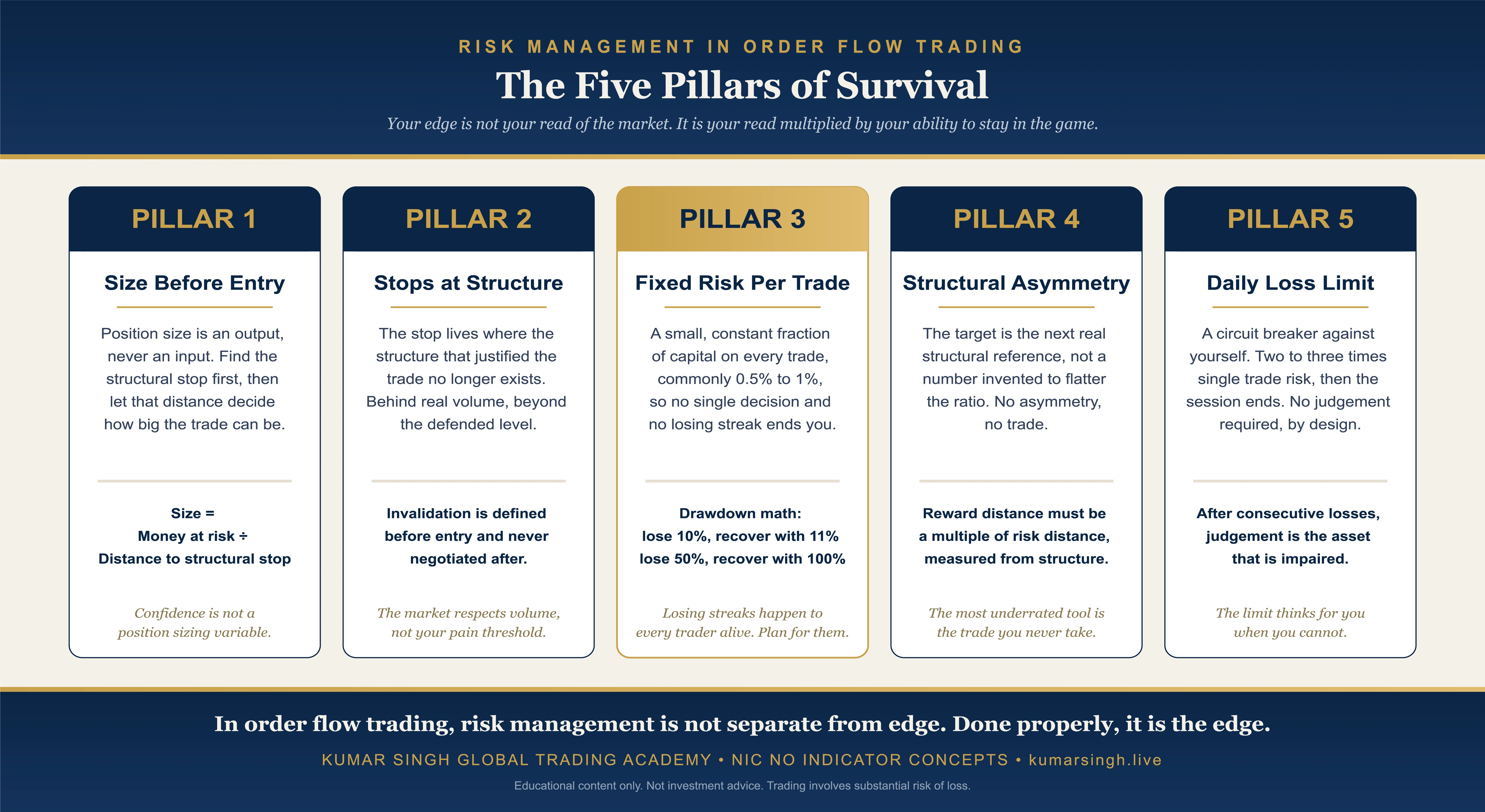
You can learn to read institutional order flow. You can learn to read the volume footprint. But if you cannot manage risk, the market will take both skills away from you before they ever mature. This is the complete framework I teach traders across five continents at Kumar Singh Global Trading Academy, written the way I say it in mentorship: direct, structural, and without a single indicator.
Here is the pattern I have watched repeat for three decades. A trader discovers order flow. The footprint chart feels like X-ray vision. Suddenly they can see buyers and sellers fighting inside every candle, and for the first time the market makes sense. So they trade bigger. They trade more often. And within months, the same insight that excited them has financed a blown account.
The chart reading was not the problem. The survival math was. Order flow gives you better information about where institutional participation sits. It does not give you immunity from being wrong. No method does, and anyone who tells you otherwise is selling something. The entire purpose of risk management in order flow trading is to make being wrong cheap and being right meaningful.
If you take one sentence from this article, take this one: your edge is not your read of the footprint. Your edge is your read of the footprint multiplied by your ability to stay in the game long enough for that read to matter.
Indicator traders manage risk against a line on a chart, a moving average, a band, an oscillator level. The problem is that those lines are derived from past price. They have no memory of where real business was done. Order flow traders manage risk against structure: the level where aggressive buyers actually showed up, the zone where volume was absorbed, the area the market accepted or rejected. That difference changes everything about where your stop belongs and how much size the trade can carry.
The footprint shows you executed business: who lifted the offer, who hit the bid, where volume clustered and where it went quiet. That gives you something an indicator never can, a structural reference point for invalidation. If institutional buying appeared at a level and price later trades cleanly through that level, your trade idea is objectively wrong. Not emotionally wrong. Structurally wrong. Risk management in order flow trading begins with this: every trade must have a structural point at which the idea is dead, defined before entry, never negotiated after.
Everything I teach in mentorship on risk reduces to five pillars. They are simple to state and hard to live. That is exactly why they work, most traders know them and do not follow them.
Size is an output, not an input. You do not decide to trade two lots and then find a stop that makes the loss tolerable. You find the structural invalidation first, measure the distance from entry to that point, and let that distance dictate the size. The formula is old and unbeatable: position size equals the money you are willing to lose on this trade divided by the per unit distance to your structural stop. When the structure demands a wide stop, you trade small. When structure allows a tight stop, size can rise without raising the rupee risk. Same risk, every trade, regardless of how confident you feel. Confidence is not a position sizing variable.
A stop loss placed at a random percentage or at the point where the loss starts to hurt is not a stop, it is a donation schedule. In order flow trading the stop goes where the structure that justified the trade no longer exists. Behind the zone where the aggressive buying appeared. Beyond the level the market defended. The market does not know your entry price and does not care about your pain threshold. It only respects levels where real volume changed hands, so that is where your protection belongs.
Professional desks survive because no single decision can end them. The retail equivalent is fixed fractional risk: a small, constant percentage of capital risked per trade, commonly between half a percent and one percent for developing traders. The arithmetic of drawdown is brutal and nonnegotiable. Lose ten percent and you need eleven percent to recover. Lose fifty percent and you need one hundred percent. Risking one percent per trade means a streak of ten consecutive losses, which will happen to every trader alive, costs roughly ten percent of capital. Painful, recoverable, survivable. Risking ten percent per trade means the same streak is extinction.
Risk to reward is meaningless when the target is invented to make the ratio look good. In structural trading the target is not imagined, it is identified: the next zone of meaningful volume, the next structural reference the market is likely to test. If the distance from entry to structural target is not a multiple of the distance from entry to structural stop, the trade does not exist. You skip it. The most underrated risk management tool in order flow trading is the trade you never take.
Exchanges halt trading when markets move too violently. You need the same mechanism, because the most dangerous market condition is not volatility, it is you after two losses, trading to get money back instead of trading what structure shows. A daily loss limit, typically two to three times your single trade risk, ends the session automatically. No judgement required, which is precisely the point. After consecutive losses your judgement is the asset that is impaired. The limit thinks for you when you cannot.
This is the foundation of NIC No Indicator Concepts, the methodology I developed across more than thirty years of independent research and now teach at Kumar Singh Global Trading Academy. Indicators are derivatives of price. They lag, they repaint in the trader's mind if not on the chart, and above all they give no honest answer to the only risk question that matters: at what point is this idea wrong? An oscillator can stay oversold while the market falls another five percent. A moving average offers no invalidation, only a moving excuse.
Structure answers the question directly. When you trade from the raw market, price, volume and the footprint of executed orders, invalidation is visible on the chart before you enter. The market itself tells you where the idea dies. That single property is why risk management and no indicator trading are not two subjects in my mentorship. They are one subject. You cannot define risk honestly if your method cannot define wrong honestly.
Institutions cannot hide their business. Size must be executed, and execution leaves footprints: absorption where their passive orders soak up aggression, imbalance where their urgency lifts offers or hits bids, volume concentrations that mark the prices where they did serious business. Reading institutional order flow does not tell you the future. It tells you something more useful for risk: where the other side of your trade is large enough to defend a level, and where it is absent.
That converts risk management from a defensive chore into an offensive weapon. You are no longer asking how much can I afford to lose here. You are asking where is the level that institutions defended, how close to it can I position, and how cheap does that make my invalidation. The closer your entry sits to genuine structural interest, the smaller your stop, the larger your permissible size, and the better your asymmetry, all without raising your rupee risk by a single paisa. This is what I mean when I tell students that in order flow trading, risk management is not separate from edge. Done properly, it is the edge.
I will be transparent about what this article can and cannot do. The concepts above are universal and I have given them to you completely. The application, how to identify which volume clusters matter, how to read absorption against aggression in live conditions, how the proprietary NIC frameworks define structural invalidation in real time, is taught live, on real markets, in mentorship. Methodology of this kind cannot be transferred through an article, and I would be lying to you if I pretended otherwise.
At Kumar Singh Global Trading Academy that teaching happens in two formats. Group Mentorship runs as a structured cohort through the full NIC Pro curriculum, twenty modules covering institutional order flow, the volume footprint and the complete structural framework, learned alongside committed traders. One on One Mentorship covers the same curriculum privately, paced and personalised to a single trader. Risk management is not a module bolted onto the end of either program. It is threaded through every framework from the first session, because that reflects how trading actually works. Traders from five continents study in these programs today, and the geography matters less than the common thread: every one of them came for the chart reading and stayed because of what disciplined structure does to their decision making.
Do I know the exact structural level at which this idea is wrong, and is my stop there rather than at a comfortable distance?
Was my position size calculated from that stop distance, or did I choose size first and rationalise afterwards?
Is my risk on this trade the same fixed fraction of capital as my last ten trades?
Is my target an actual structural reference, or a number invented to flatter the risk to reward ratio?
If this trade loses, am I within my daily loss limit, and will I genuinely stop when it is hit?
Am I taking this trade because structure demands it, or because the last trade lost?
If any answer makes you uncomfortable, you have found today's real work. It is not on the chart.
This article is published for educational purposes only and does not constitute investment advice, a recommendation, or a solicitation to buy or sell any security or derivative. Trading in financial markets involves substantial risk of loss and is not suitable for every individual. Past market behaviour does not guarantee future results. Kumar Singh Global Trading Academy is an educational institution and is not registered with SEBI or any other financial regulatory authority in any jurisdiction, and does not provide investment advisory, portfolio management or broking services. Readers should consult a registered investment adviser before making financial decisions.
Direct answers on stops, position sizing and survival in order flow trading. The same questions students bring to mentorship, answered without fluff.
Risk management in order flow trading is the discipline of defining, before entry, exactly where a trade idea is structurally invalid, sizing the position from that distance, and capping risk per trade and per day at fixed fractions of capital. Unlike indicator based methods, order flow trading uses executed volume and market structure to locate invalidation, which makes risk objective rather than emotional.