We Teach Trading — Zero Tips, Zero Advice, Zero Recommendations. Not registered with SEBI or any financial regulator worldwide.
We Teach Trading — Zero Tips, Zero Advice, Zero Recommendations. Not registered with SEBI or any financial regulator worldwide.
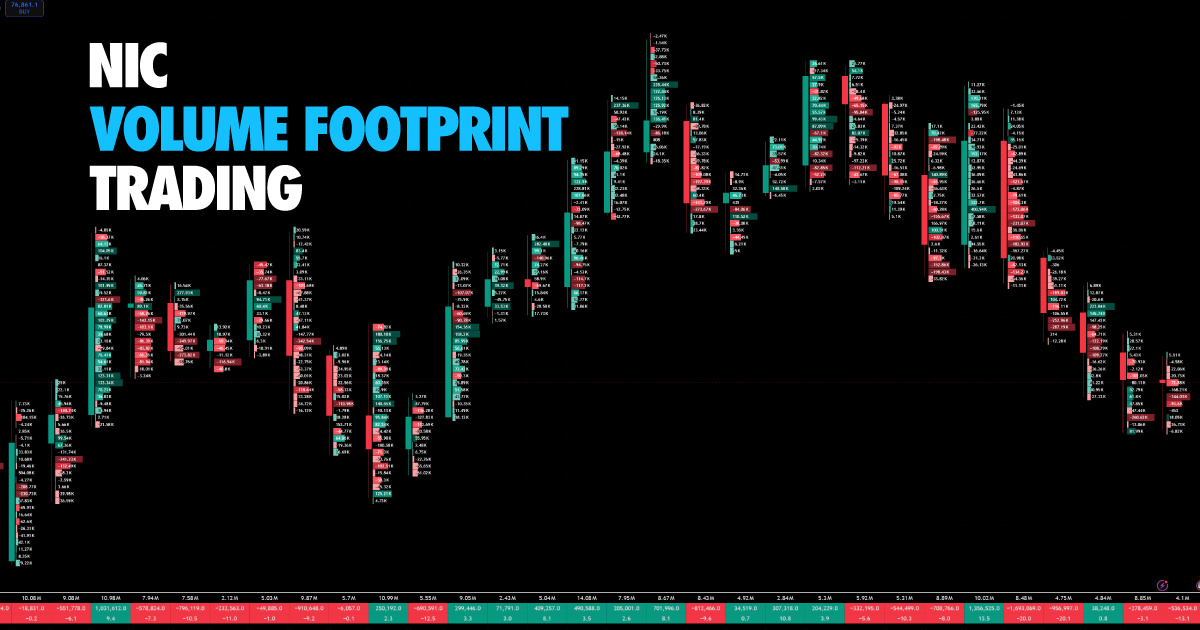
A first-principles guide to volume footprint, the institutional order flow reading tool that shows you what indicators cannot. Written for Indian traders learning the No Indicator Concepts methodology at Kumar Singh Global Trading Academy.
Most Indian traders trade what they see on the chart. Candles, moving averages, RSI, MACD, Bollinger Bands. They watch the indicator. They react.
But the chart is the result. Not the cause.
The cause is order flow. Money moving in and out of the market, contract by contract, tick by tick. Volume footprint is the chart type that shows you that flow directly.
A volume footprint candle is not just a candle. It is a structured grid inside each candle that displays exactly how many contracts were transacted at every single price level inside that candle's range. And crucially, whether each transaction happened at the bid or the ask.
In a normal candlestick chart, you see open, high, low, close. In a volume footprint chart, you see that plus the bid volume, the ask volume, the delta, and the total volume at every price level inside the candle.
That is a level of resolution no indicator can replicate. Because indicators are mathematical derivatives of price. Volume footprint is the actual transaction record.
For the past decade, the Indian retail trading boom was built on indicators. Every YouTube course, every Telegram channel, every coaching class taught some combination of RSI, MACD, Supertrend, VWAP, and a few proprietary indicators rebranded with new names.
The result, by SEBI's own published data, is well documented. The vast majority of retail intraday traders in the cash and derivative segments end the financial year with net losses. The framework is not working.
The traders who are paying attention have noticed something else. The funds, the proprietary desks, and the institutional participants on the other side of their trades are not using indicators. They are reading order flow.
Volume footprint is how that gap closes. It is the same lens institutional desks use, made available to a serious retail trader willing to learn it properly.
This is the foundation of the No Indicator Concepts methodology, known as NIC, taught at Kumar Singh Global Trading Academy. The premise is simple. Markets do not move on indicators. Markets move on money. Volume footprint shows you the money.
Every footprint candle, regardless of timeframe, is built on four data points at each price level inside the candle's range.
Bid Volume. The number of contracts that were transacted at the bid price. These are aggressive sellers, market participants willing to accept the lower side of the spread to exit or initiate a short position.
Ask Volume. The number of contracts that were transacted at the ask price. These are aggressive buyers, market participants willing to pay the higher side of the spread to enter or cover a short position.
Delta. The difference between ask volume and bid volume at that price level. Positive delta means aggressive buying dominated. Negative delta means aggressive selling dominated. Delta near zero means the participation was balanced.
Total Volume. The sum of bid and ask volume at that price level, regardless of direction. This shows where the heaviest activity happened, independent of who was winning the auction at that level.
When you read these four data points across an entire candle, and then across a sequence of candles, you stop guessing what the market is doing. You start reading what the market has already done.
Institutional participants move size. A mid-tier fund desk might transact several thousand Nifty contracts in a single session. A larger institutional desk might transact tens of thousands. That volume has to go somewhere, and when it does, it leaves a footprint.
The footprint shows up as imbalances. An imbalance is when the ask volume at a specific price level significantly exceeds the bid volume at the level diagonally below it, or vice versa. A common threshold used in practice is 300 percent to 400 percent, though the exact figure depends on the instrument, the time of day, and the prevailing volatility.
When you see a vertical column of buy imbalances stacked through a candle, you are looking at aggressive institutional buying. Not retail buying. Retail does not move in that pattern. Retail trades are distributed and noisy. Institutional flow is concentrated and directional.
That is the reading skill. Distinguishing institutional footprints from retail noise. It cannot be automated by an indicator because the context matters. Where the imbalance occurred. What was happening on higher timeframes. Where the price was relative to prior structure. All of this is interpretation, and interpretation is what NIC trains.
Intraday traders on NSE and BSE work in narrow time windows. The opening session, the lunch lull, the closing session. Each has its own character, its own participant mix, its own footprint signature.
Volume footprint reveals which moves in those sessions were absorbed and which were continued.
An absorption pattern looks like this. Price moves into a level. The footprint generates significant volume at that level. But the candle fails to extend through the level. Heavy volume. Neutral or reversing delta. Static price. That is institutional absorption. Someone with size took the other side of the move.
For intraday application on Indian markets, the key footprint reads include:
The first 15 to 30 minutes of the session, where opening order flow establishes the directional bias for the rest of the day.
The reaction at key reference levels, including the previous day's high, low, and value area extremes.
The closing auction window, where institutional rebalancing creates some of the cleanest footprints of the entire trading session.
These are concepts to study. Not signals to act on blindly. They become tradable only when paired with structure, context, and the rest of the NIC framework.
Options are a derivative instrument. But they trade on underlying flow. The Nifty option chain reacts to Nifty futures flow. Bank Nifty options react to Bank Nifty futures flow. If you want to trade options seriously, you read the underlying footprint, not the option premium chart.
Volume footprint helps options traders in three specific ways.
First, it shows aggression at strike-relevant levels. When the underlying futures show heavy buy imbalances near a specific strike, that flow tells you something about how option market makers are likely to hedge their delta exposure.
Second, it reveals exhaustion. When price moves into a strike with high open interest and the footprint shows decelerating delta on rising volume, that is a sign of supply absorbing demand. Useful information for an option seller deciding whether to fade a move into that strike.
Third, it provides intraday context for positional option strategies. A trader holding a 30-day positional spread benefits from knowing whether today's intraday move is institutional accumulation or retail noise.
In the NIC Pro curriculum at Kumar Singh Global Trading Academy, the options module pairs volume footprint with delta, IV behavior, and PCR analysis. The footprint is the input. The greeks tell you how to express the read inside the option chain.
Swing traders hold positions for multiple days, often four to fifteen sessions. The footprint read at this timeframe is less about individual candle imbalances and more about cumulative delta across a multi-session window.
When a stock or index spends three to five sessions with persistent positive delta into a key resistance and fails to break, that is a stalling pattern. The buying is there. The breakout is not. That asymmetry is the information.
The reverse is also true. When price holds a support across several sessions with steady negative delta but no breakdown, sellers are exhausting themselves into a buyer who is absorbing them quietly. These are the patterns the No Indicator Concepts methodology trains traders to recognize across timeframes.
For Indian swing traders, the most useful contexts to read volume footprint at the multi-day level include:
NSE F&O stocks during expiry weeks, when institutional positioning shifts most aggressively.
Index futures across global macro events such as Fed meetings, US CPI releases, and major domestic policy announcements.
Sector indices around quarterly results seasons, when sectoral institutional flow concentrates.
The footprint shows you which moves had real institutional participation and which were retail-driven spikes that faded.
Positional traders work in weeks to months. At this scale, volume footprint is read at the daily and weekly candle level, often paired with periodic volume profile to map institutional reference zones across the broader market structure.
The concept here is straightforward. Major institutional accumulation and distribution leave footprints that persist. A weekly candle with significant cumulative volume and a clear delta direction tells you that real money positioned itself during that week. That zone becomes a reference for months ahead.
The Institutional Order Flow and Volume Footprint 1-2-3 Formula, one of the core proprietary frameworks taught at Kumar Singh Global Trading Academy, uses these long-term footprint reference zones to map structural pivots that retain validity across multiple market cycles.
Positional trading is where the footprint payoff compounds. The reads are fewer. The conviction is higher. The risk management is cleaner. Most importantly, the noise of intraday session activity is filtered out, leaving only the patterns that matter at scale.
Most traders who attempt to learn volume footprint without a structured methodology fail. Not because the tool is wrong. Because the framework around it is missing. Here are the five patterns that derail most self-taught attempts.
Treating delta as a signal. Delta is a data point. Not a directional cue. A positive delta candle in the wrong context is meaningless. The context determines the meaning.
Ignoring the higher timeframe. A buy imbalance on a one minute chart inside a daily downtrend is noise. The same imbalance on a one minute chart at a daily demand zone is signal. The framing matters more than the reading.
Using footprint without volume profile. Footprint shows you what happened inside a candle. Volume profile shows you where the market has historically valued price. Without the profile context, the footprint floats untethered.
Trying to backtest footprint mechanically. Footprint reading is interpretive. It does not reduce to a rule-based system. Attempts to systematize it through scripts and bots almost always fail because the read depends on context that varies session to session, day to day.
Switching back to indicators when the footprint is confusing. This is the most common failure. A trader gets confused by a footprint pattern and reaches for RSI to confirm. That defeats the entire purpose. If you do not understand the footprint, the answer is more study. Not a fallback to a tool you already know does not work.
The No Indicator Concepts methodology, developed and taught by Kumar Singh, treats volume footprint as one of several institutional reading frameworks. It is not the entire system. It is one lens in a multi-lens approach.
The NIC Pro curriculum at Kumar Singh Global Trading Academy structures the volume footprint education across these progressions:
The four-component read at the single candle level.
Sequence reads across multiple candles within a session.
Higher timeframe integration with daily and weekly candles.
Pairing footprint with periodic volume profile for institutional reference mapping.
Application across intraday, options, swing, and positional contexts.
Pairing footprint with the 1-2-3 Formula, the Institutional FVG Framework, and the Engulf Cycle Strategy for a complete structural read.
This is not a recorded course you watch and forget. It is a live mentorship, available as group or one-on-one, with continuous interaction, real chart breakdowns, and direct feedback on student reads.
If you have spent two or three years on indicators and have noticed the framework is not working, volume footprint is the upgrade. And NIC is the structured path to learning it properly.
Kumar Ravishanker Singh, professionally known as Kumar Singh, is the founder of Kumar Singh Global Trading Academy. An independent trader, trading mentor, and independent technical researcher, he developed the No Indicator Concepts methodology after years of study in institutional order flow, volume footprint, structural market reading, and the proprietary frameworks that form the core of the academy's curriculum.
The academy serves Indian and international students through a live, mentorship-driven model. There are no recorded courses. Every session is delivered in real time with direct interaction.
To learn more about NIC, the program structure, and the mentorship tiers (NIC Fundamentals, NIC Pro Group, and NIC Pro 1:1), visit the Mentorship page at kumarsingh.live.
The content on this page is for educational purposes only. Nothing on this page constitutes investment advice, a trading recommendation, or an offer to buy or sell any security or derivative.
Trading and investing in financial markets involves substantial risk. Past performance is not indicative of future results. The concepts and frameworks discussed are educational in nature and do not guarantee any specific outcome.
Kumar Singh Global Trading Academy is an educational platform. It does not provide investment advisory services, portfolio management services, or research analyst services as defined under SEBI regulations. The content is designed to teach trading concepts and methodologies. Application of these concepts in live markets is the sole responsibility of the individual.
This disclaimer extends globally and applies in jurisdictions regulated by SEBI (India), FCA (United Kingdom), SEC and FINRA (United States), ASIC (Australia), MAS (Singapore), CySEC (Cyprus), ESMA (European Union), FSCA (South Africa), and other recognized financial regulators.
A volume footprint chart is a type of price chart that displays the exact number of contracts transacted at every price level inside each candle, along with whether each transaction occurred at the bid or the ask. Unlike a standard candlestick chart that only shows open, high, low, and close, a volume footprint reveals the bid volume, ask volume, delta, and total volume at every individual price level inside the candle. This makes it the closest available view of actual institutional order flow for retail traders.