We Teach Trading — Zero Tips, Zero Advice, Zero Recommendations. Not registered with SEBI or any financial regulator worldwide.
We Teach Trading — Zero Tips, Zero Advice, Zero Recommendations. Not registered with SEBI or any financial regulator worldwide.
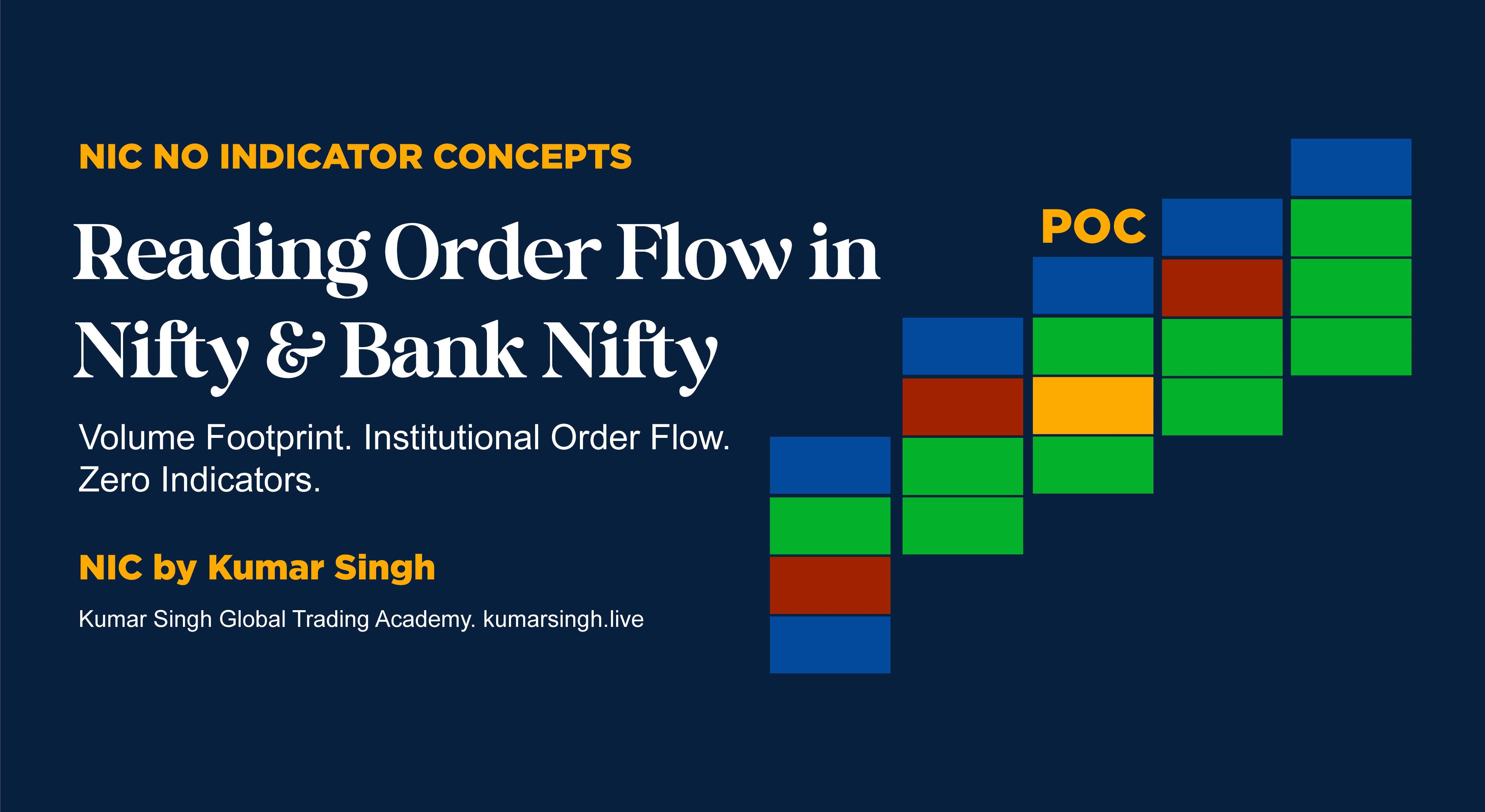
The market doesn't move on indicators. It moves on money. Here is how to read where that money is actually going.
A candle closes red. You think sellers won. The next candle closes green and takes out your stop. You think you read it wrong. You didn't read it wrong. You read the wrong thing.
The candle is a summary. By the time it closes, the decision has already been made, and you spent the whole time watching the scoreboard instead of the game. Order flow is the game. It is watching who is buying, who is selling, and who is winning the fight, while the candle is still being built.
In Nifty and Bank Nifty, this is not theory borrowed from some American trading book. It is the actual mechanism the market runs on, every single tick. Let us read it the way it should be read.
Start with a correction, because plenty of educators in India get this wrong and pass the mistake to their students.
The Nifty and Bank Nifty number you see quoted, the spot index, has no order book. It is a calculated value. A weighted average of its constituent stocks. Nobody places a bid or an offer on the index itself. So there is no bid and ask being matched, no real order flow, no footprint to read on spot.
Order flow lives on the futures. The Nifty future and the Bank Nifty future are real contracts with a real order book. Real resting limit orders. Real aggressive market orders hitting them. That is where bids and asks get filled and matched. That is where the auction happens. So when a serious trader talks about reading order flow in Nifty and Bank Nifty, they mean the futures, or the options premium, never the spot line.
Get this one thing right and everything downstream makes sense. This is the kind of foundation that NIC, the No Indicator Concepts methodology taught by Kumar Singh, is built on. Mechanism first. Always.
Every move in Bank Nifty, every move in Nifty, comes down to two participants doing two different things.
The limit order is patient. It rests in the book at a price and waits. It says come to me, I will buy here and only here. Limit orders are liquidity. They are the supply sitting quietly in the market.
The market order is aggressive. It does not wait. It crosses the spread and takes whatever is resting. It says fill me now, at whatever price the book is showing. Market orders are intent in a hurry.
Price moves when aggression overpowers liquidity. When aggressive buyers keep lifting offers faster than sellers can refill them, price rises. When aggressive sellers keep hitting bids faster than buyers refill, price falls. That is the engine. Everything else painted on your chart is decoration on top of this.
Bank Nifty makes this vivid. It moves faster and harder than Nifty, driven by a small, heavy set of banking names. Watching aggression meet liquidity on Bank Nifty is the difference between reading the move and chasing it after it is gone.
Delta is the cleanest honest measure of aggression. It is the difference between volume that traded on the offer, the aggressive buying, and volume that traded on the bid, the aggressive selling.
Positive delta. Aggressive buyers were lifting offers. Negative delta. Aggressive sellers were hitting bids. Simple enough, and this is where most retail traders stop and lose the real signal.
Here is the part that matters. Delta tells you intent. It does not tell you the outcome. The real question is what price did in response to that intent.
Heavy buying and price rises? Straightforward. Buyers pushed, price went. But heavy aggressive buying and price does not rise? Now something important is happening. Someone is absorbing all of that buying with resting sell orders. The aggression is real, but it is being eaten alive. That absorption is often exactly where a move is about to fail, and it is completely invisible to anyone staring at the candle alone.
So do not read delta as a final score. Read it as a question. Aggression happened. Did price reward it, or absorb it? Learning to answer that question live, candle by candle, is a trained skill. It is the heart of what NIC Pro builds in a trader.
Inside any candle, any session, volume does not spread evenly. It clusters. The price where the most volume traded is the point of control. The level the market agreed was fair enough to do the most business at.
The point of control matters because the market remembers it. Price tends to return to levels where heavy trade happened, because that is where large positions and unfinished business sit. On Nifty and Bank Nifty, tracking where the point of control sits, and more importantly which way it migrates session over session, tells you which way the centre of gravity is shifting.
A point of control drifting higher day after day is volume agreeing to do business higher. Drifting lower is the opposite. One number means little. The direction it travels means everything. This is volume footprint reading at its most practical, and it is teachable, with the right eyes guiding yours.
An auction finishes when price reaches a level, gets rejected, and turns away cleanly, leaving that extreme settled. An auction is unfinished when price pokes at a high or a low and the activity there suggests the level was never fully resolved. The market started something and walked away.
Markets tend to come back and finish what they started. An unfinished low is an open invitation for price to return and test it again. An unfinished high, the same. Reading these correctly, from the footprint rather than guessing from a candle wick, is one of the most useful skills in order flow trading.
It is also one of the easiest things to read wrong on your own. This is precisely where live instruction earns its place, and where the NIC Pro mentorship moves a trader from guessing to reading.
They run on the same mechanic, bids and asks being filled and matched, but they behave differently and you must respect that.
Bank Nifty is fast, volatile, and heavy. Order flow moves quickly. Absorption and exhaustion show up sharply. The swings are wide. It rewards a trader who can read aggression in real time and punishes one who hesitates.
Nifty is broader and generally calmer. The same order flow develops with a little more patience. The reading is the same. The tempo is gentler.
A trader who learns to read one can read the other, once they respect the change in speed. The principles travel. The instrument changes, the reading does not.
Most Indian retail traders live in Nifty and Bank Nifty options, not futures. Order flow can be read there too, with one sharp caveat. You are reading the order flow of the option premium, not the index. The premium has its own bid and ask, its own auction, its own liquidity that thins out fast as you move away from the money.
The same concepts apply. Aggression, absorption, point of control, unfinished auctions. But the price scale and the liquidity behave very differently from the futures, and that changes how everything is read and calibrated. Trading options order flow without understanding this is how good readers still lose. It deserves its own dedicated treatment, which is exactly what the deeper NIC Pro modules provide.
An indicator is built from price after the fact. RSI, moving averages, every oscillator you have ever tried. They take price that has already happened and reshape it into a line. They are always looking backward, because that is all they can do.
Order flow shows you the money while it moves. The aggression, the absorption, the levels where institutions are quietly doing their work. It is the only reading that shows you the decision being made instead of the decision already made.
That is the entire idea behind NIC, No Indicator Concepts. Not a clever marketing line. A different place to look. Stop reading lines drawn from old price. Start reading the order flow that is creating the next price.
Order flow is not a magic lens that prints money. It is a skill. It takes screen time, correct instruction, and the discipline to read what is actually on the chart rather than what you are hoping to see. Most traders never get there alone, because the nuances, the absorption reads, the calibration, the judgment in the borderline moments, are very hard to learn from a video or a free PDF.
That is the work Kumar Singh does inside NIC Pro. One trader at a time, or in a small focused room, reading live Nifty and Bank Nifty order flow until it stops looking like noise and starts looking like a language you can read.
If you have spent years on indicators and you are tired of reacting to candles after the move is gone, this is the other road. The market has a language. Learn to read it.
Explore the NIC Pro mentorship and learn institutional order flow and volume footprint the way the market actually trades. Secure your seat in the mentorship.
Kumar Ravishanker Singh, professionally known as Kumar Singh, is an independent trader and trading mentor and the founder of Kumar Singh Global Trading Academy. This article is for educational purposes only. It explains market-reading concepts and does not constitute investment advice, a recommendation, or a solicitation to trade. Trading in financial markets carries risk. Outcomes depend on individual skill, discipline, and market conditions, and past learning or examples do not assure any particular result. Make your own decisions or consult a registered financial adviser.
Order flow trading is reading the live buying and selling activity in the market, the actual bids and asks being filled and matched, instead of relying on indicators built from past price. In Nifty and Bank Nifty it is read on the futures and options, where a real order book exists, not on the spot index, which is only a calculated value with no order book. The aim is to see where institutional money is entering, absorbing, and exiting while the candle is still forming, rather than reacting after it closes.